


Regent Seven Seas Grandeur
We enjoy a culinary adventure aboard Regent Seven Seas Grandeur
A “Spotlight on Cuisine” Cruise
By John and Sandra Nowlan
A culinary theme cruise is always appealing, especially on an ultra-luxury line like Regent. In this case the unusual ten-day itinerary made it even more fascinating. We started in Amsterdam, sailed through the North Sea to begin our visits to several ports in Scotland and Wales before disembarking in Le Havre, France, for flights home from Paris.
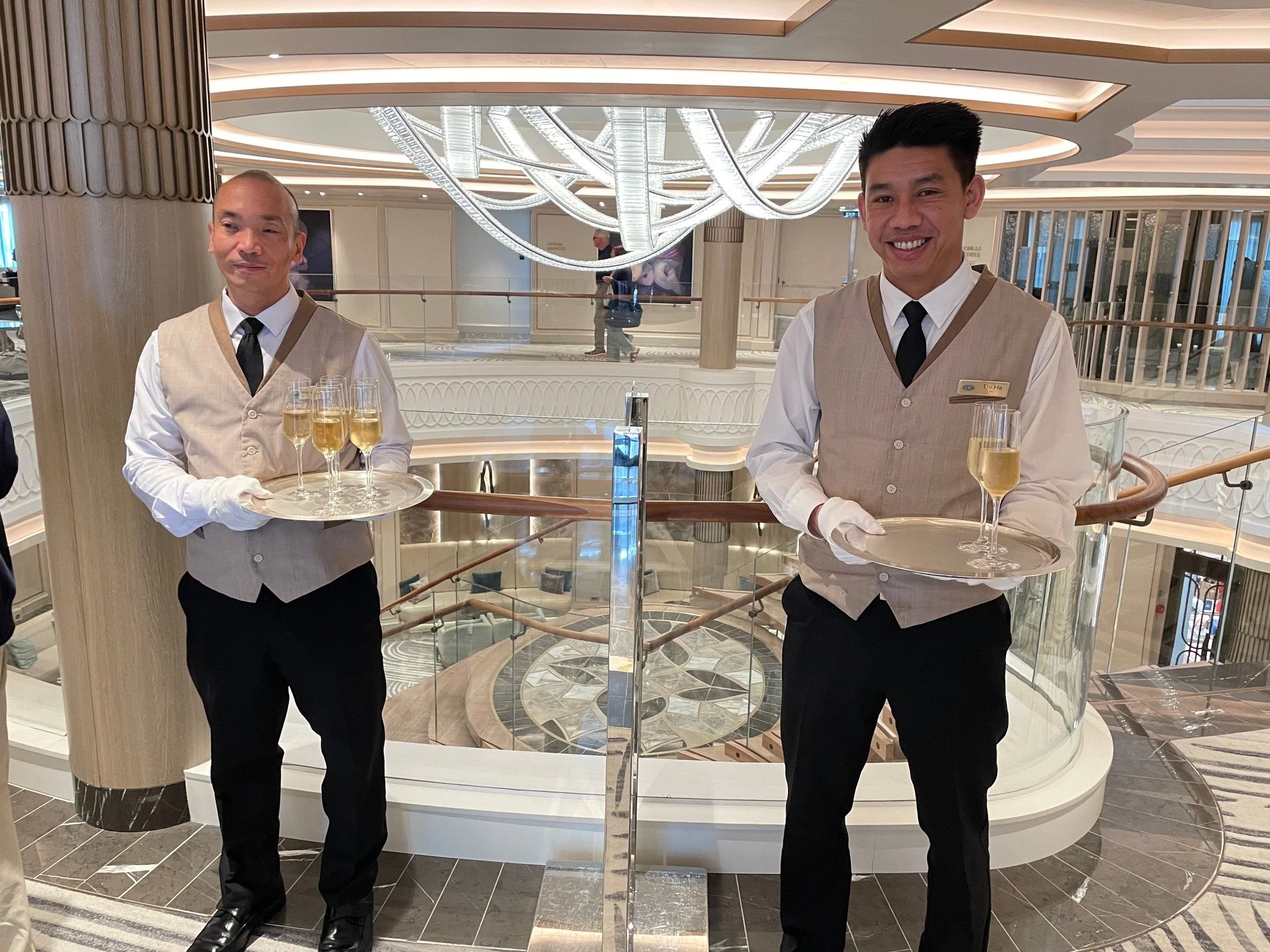
Champagne Reception
After an easy boarding process and champagne welcome on Regent’s newest ship, the 746 passenger Seven Seas Grandeur we, like many guests, headed for the buffet restaurant on deck 11 while passing and admiring some of the 300,000 pounds of polished marble, 503 chandeliers and the ship’s $6 million art collection including three Picassos and a unique Fabergé egg. Public spaces were stunning!
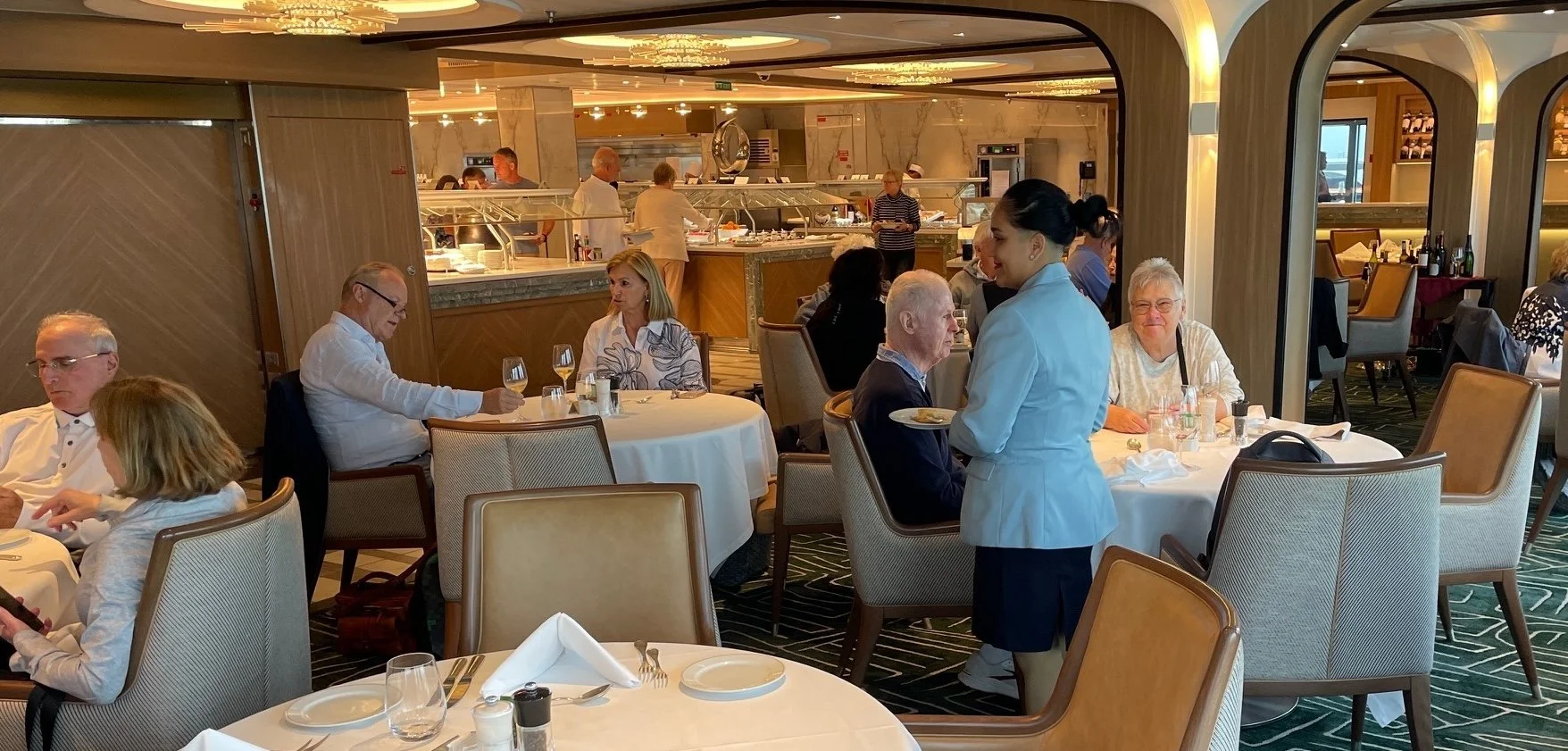
Le Veranda, Grandeur’s buffet restaurant
Le Veranda, the buffet restaurant, was surprisingly elegant. Every table had a white linen tablecloth with high end German made Schonwald dinnerware and quality Sambonet silver plate flatware. Not your ordinary cruise ship buffet setting. And the food was certainly not ordinary with an appetizing choice of several hot dishes including a prime rib carving station, freshly steamed vegetables and imaginative desserts. We were offered choices of complimentary wine, beer or cocktails, even tasty non-alcohol versions.
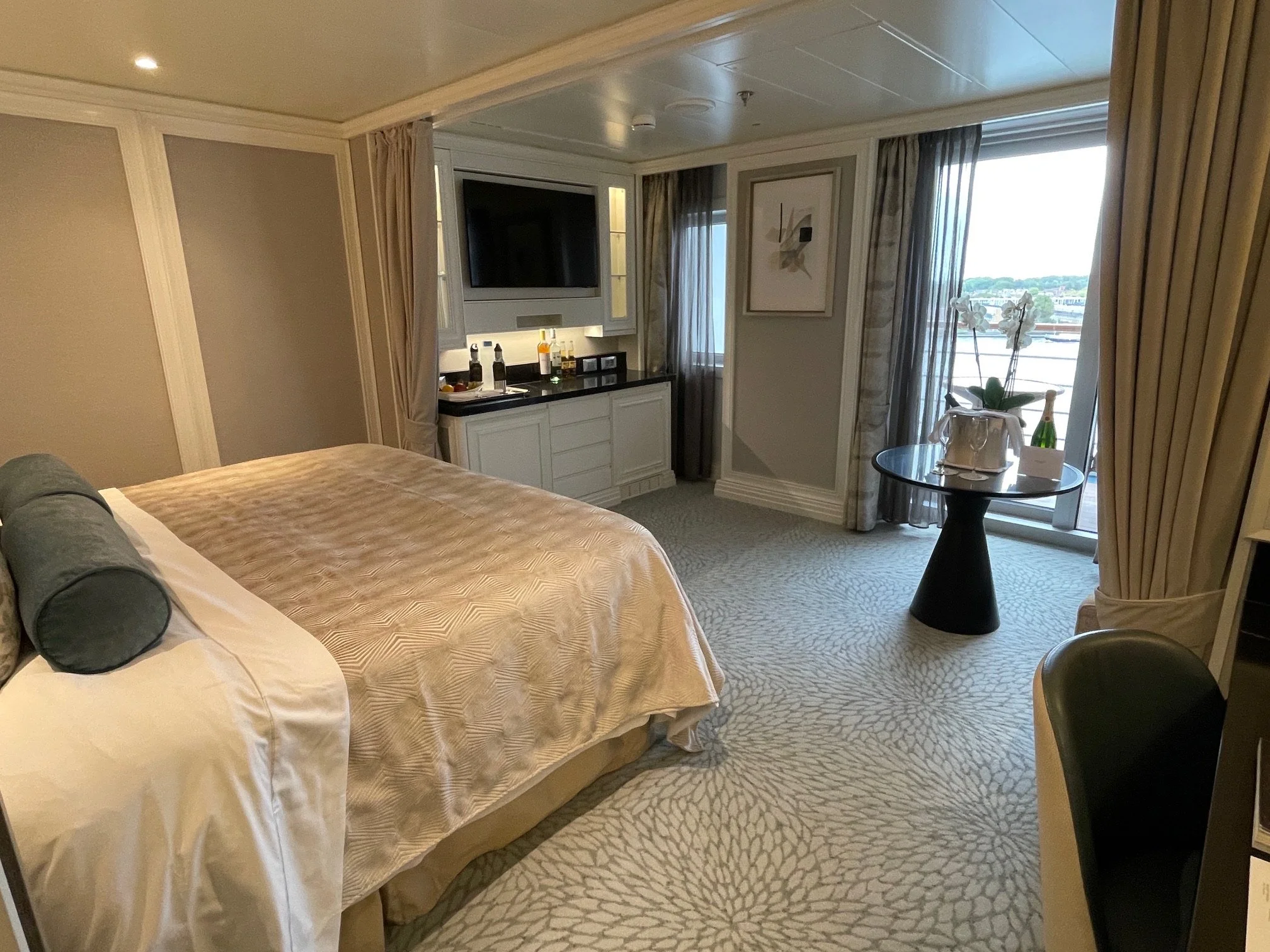
The Nowlan’s generous sized suite
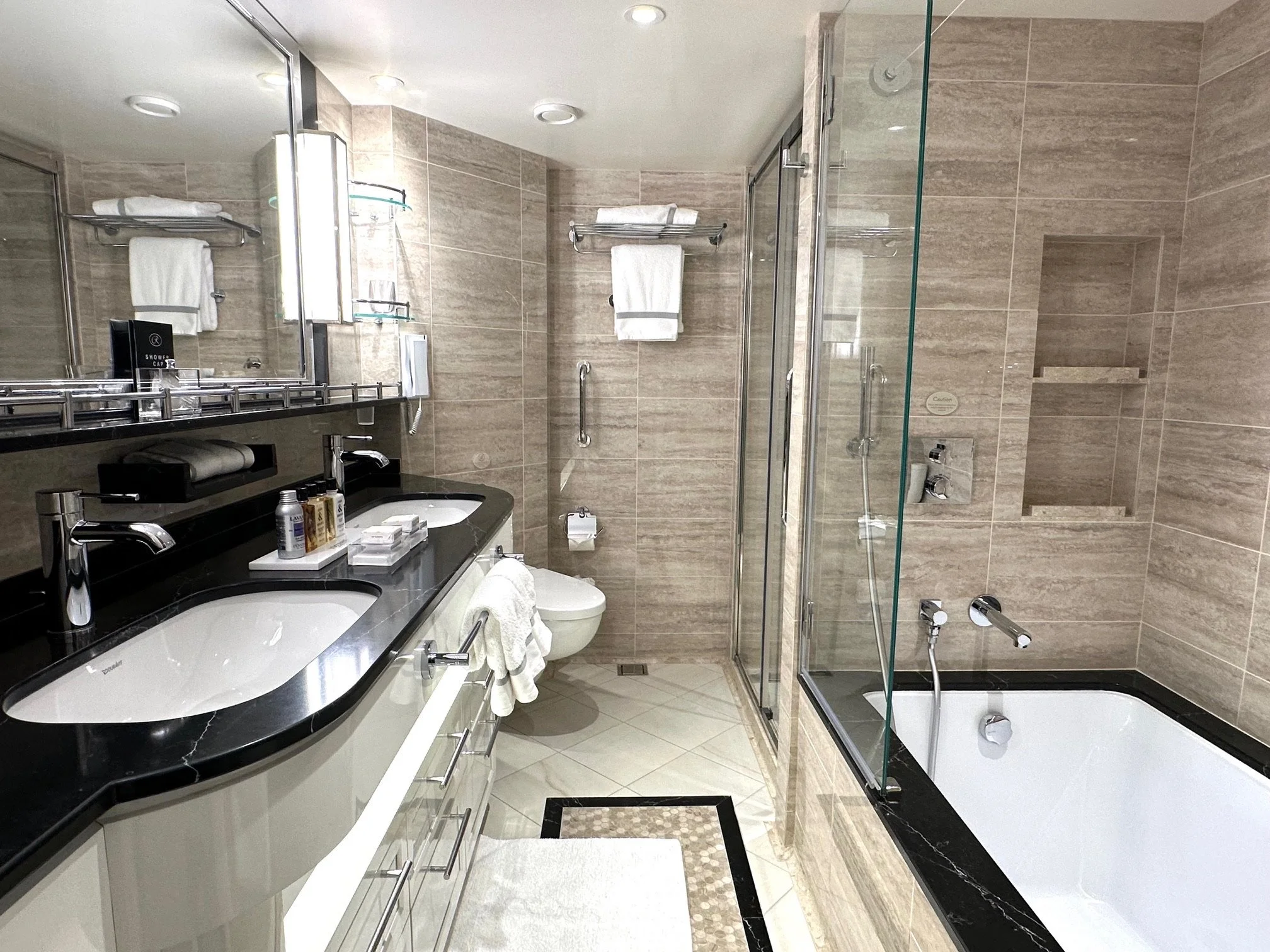
Outstanding bathrooms on Grandeur
After lunch we unpacked, reviewed the safety video and admired our large 331 square foot balcony suite. It featured a king size bed with luxurious, high thread-count sheets, convenient lighting and power outlets with plenty of storage space and a walk-in closet. The bathroom had both a tub and separate shower with double sinks and convenient space for all our toiletries. We’d rate it as among the best cruise ship bathrooms we’ve ever seen. A heated floor would have made it perfect.
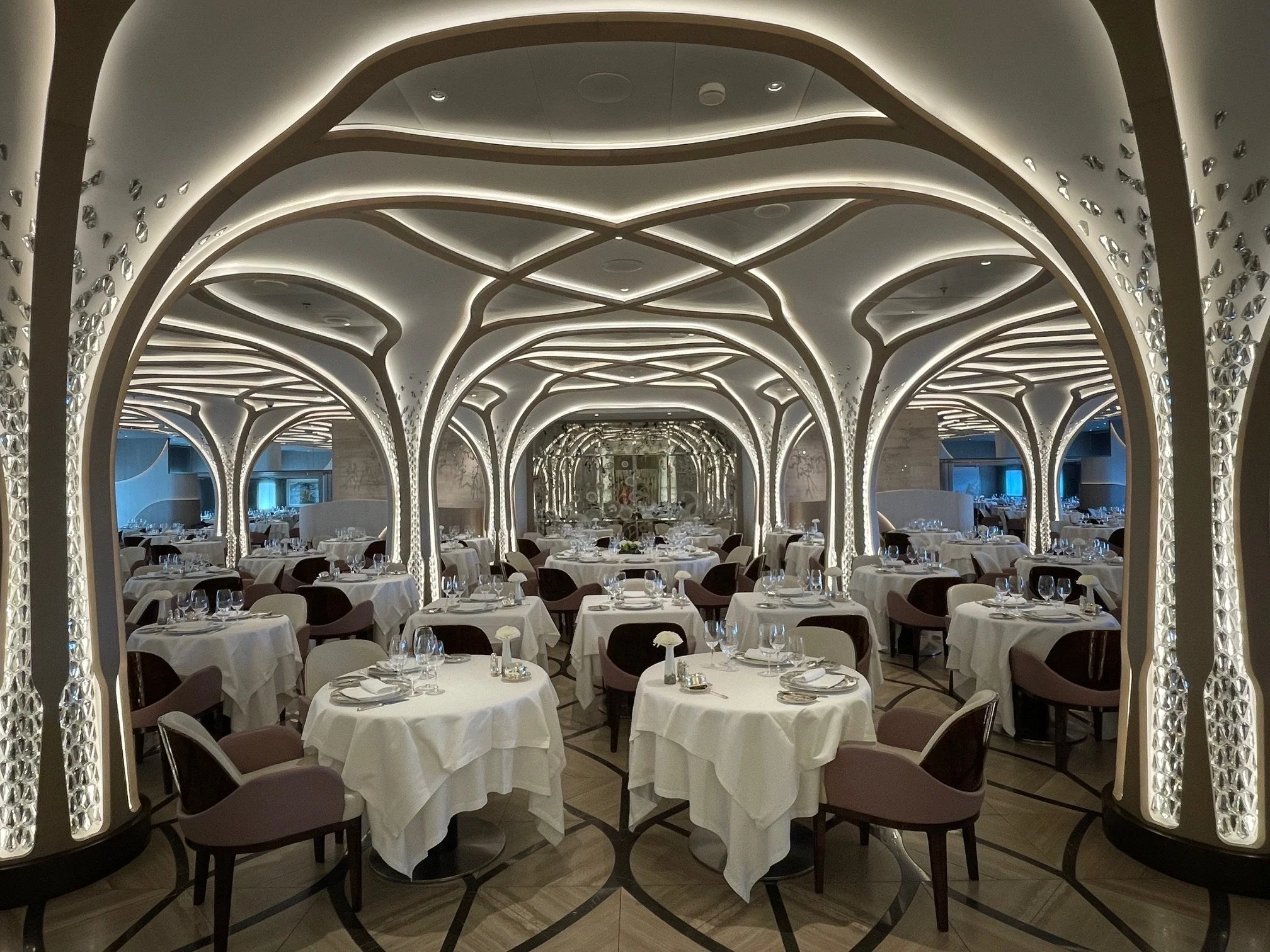
The elegant and unique Compass Rose main dining room
Our first meal on Grandeur, the buffet, showed us the high level of service from some of the 548 well-trained staff and the ship’s attention to detail. We were even more astonished as we headed for dinner at Compass Rose, the main dining room. With a simulated cascading waterfall at the entrance, the large, imaginative room resembled an enchanted forest of trees forming a canopy with dazzling jewels on their trunks. It was spectacular during the day but we were in awe as night approached and the sides of the room turned into an optical illusion of infinity.
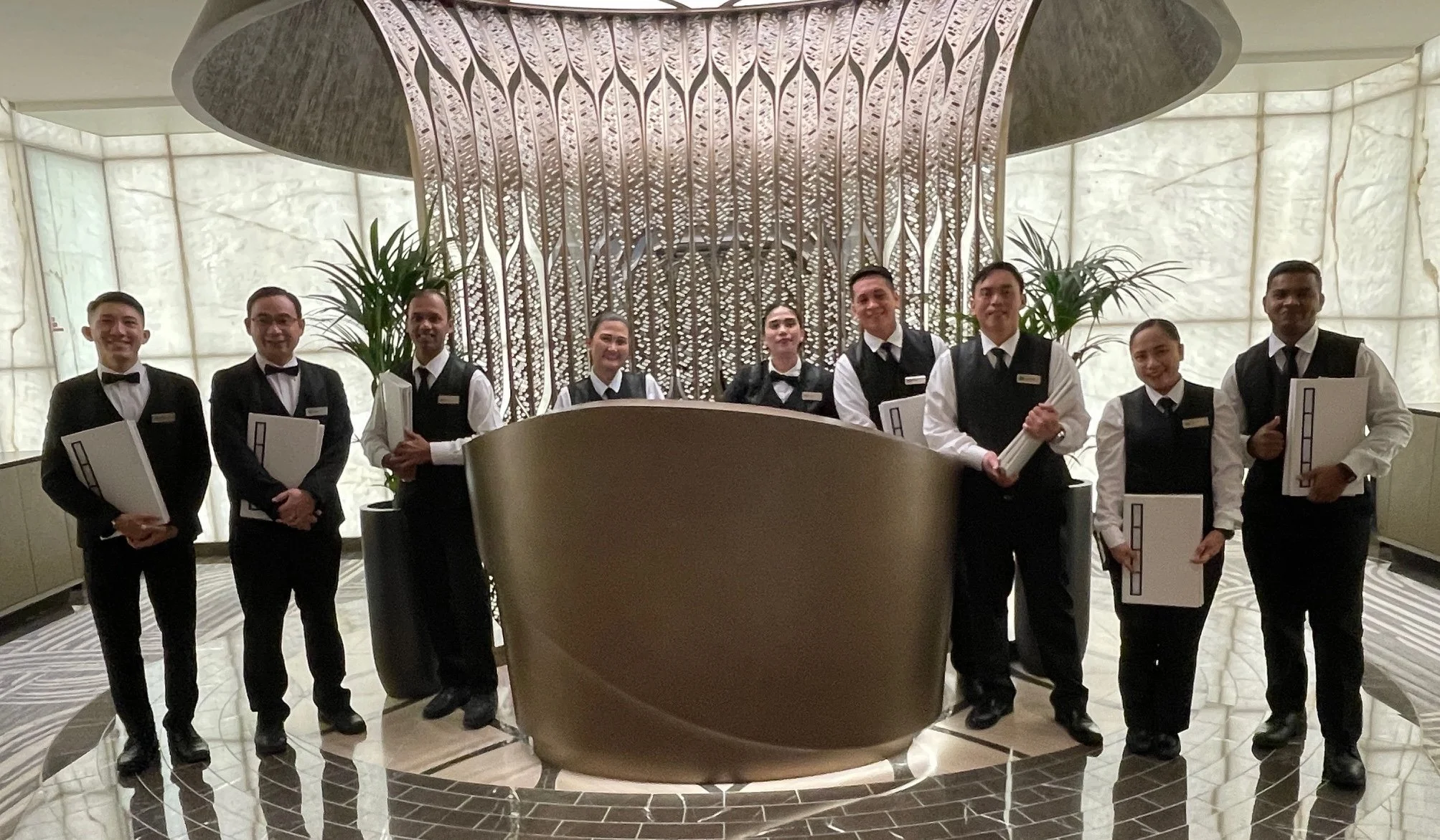
Compass Rose entrance. Waiters ready to escort guests to tables
The menu in Compass Rose was the most complete we’ve ever seen on a cruise ship. In addition to a wide choice of daily specials on the right side, the left side of the large menu had an “Always Available” list of more than a dozen favorites ranging from Black Angus Filet Mignon to whole Dover Sole with many sauces and choices of side dishes. One guest told us he ordered Lobster Tail every evening for dinner. The Rossini style tenderloin with seared foie gras we ordered was the best piece of beef we’ve enjoyed on any cruise.
Chef John Stephano in his Culinary Arts Kitchen
To our disappointment, the well-promoted guest celebrity chef, Christopher Gross, a James Beard Award winner, didn’t make an appearance until near the end of the cruise but it gave us a chance to sample Grandeur’s three specialty restaurants. But before trying them we passed the ship’s extensive library and headed to the bright and well-equipped Culinary Arts Kitchen on Deck 11 to meet its cheerful and knowledgeable Chief Instructor, Chef John Stephano of Philadelphia. His extra-cost classes ($US89) for 18 students are held each day, twice on sea days. “Because most of our guests are well traveled and sophisticated,” he told us, “my classes try to teach something new – a deep dive to the area, to the region.” He said he wants guests to understand the history of a cuisine. “If we can impart the richness and culture of the past, then guests have a better understanding of how the food affects their palate. Most people consume food. We want guests to taste it.” Chef Stephano had planned to take guests on a shopping and cooking expedition in Invergordon, Scotland, but the trip was cancelled when it was discovered that the preferred butcher shop was closed on Sundays.
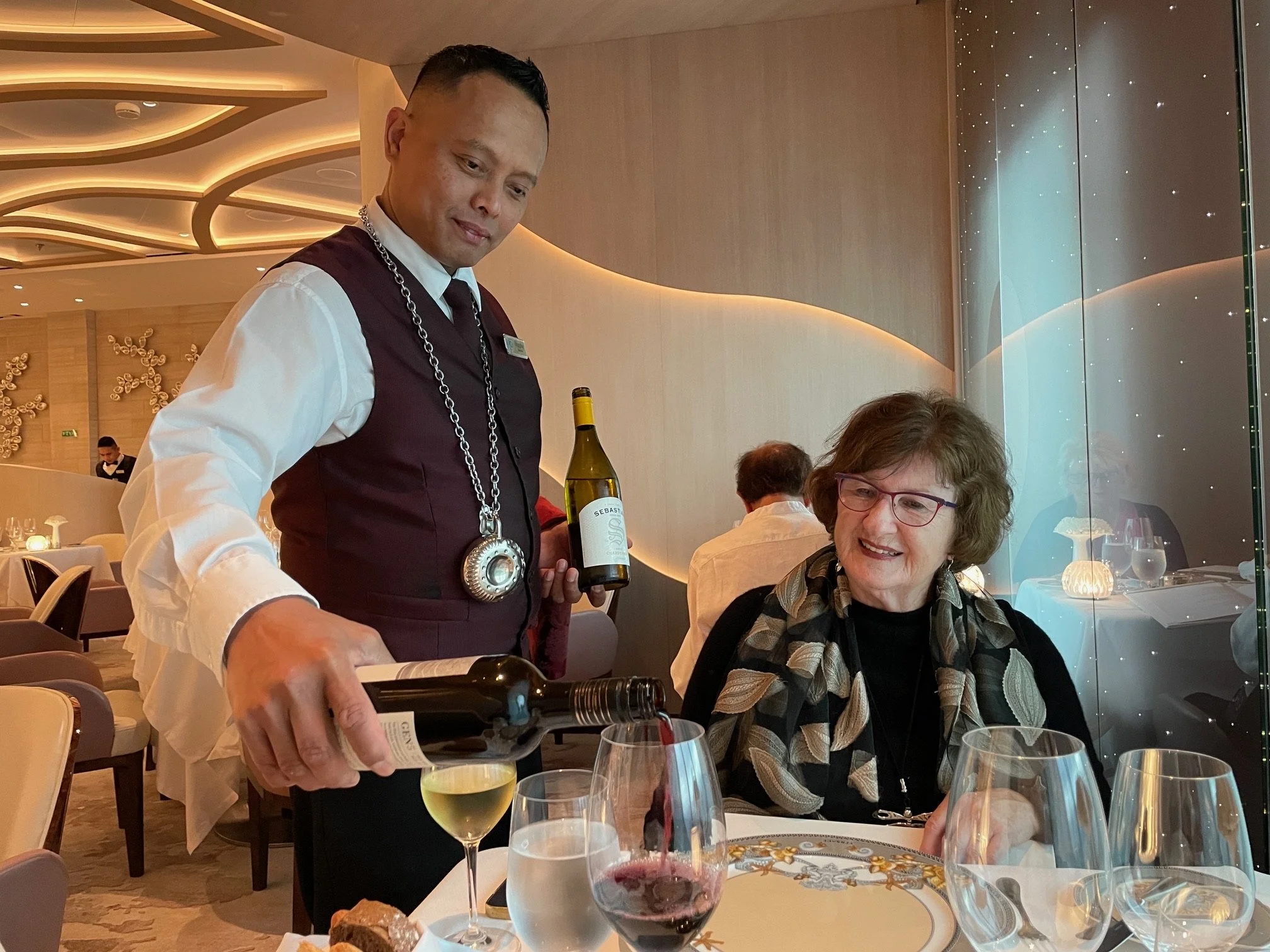
Complimentary wine in all restaurants
Taste was our objective over the next few days as we tried the three complimentary specialty restaurants. Appropriately, the entrance to the Deck 5 Pacific Rim Asian restaurant had a full size bronze Bonsai cherry tree with pink petals of Murano glass. We enjoyed several imaginative items from its extensive menu including Peking duck & watermelon salad, Canadian lobster tempura, pork and shrimp dim sum and flavorful miso black cod. Our optional chopsticks were put to good use. The other two specialty restaurants were close to each other on Deck 10. Typical of a good steakhouse, Prime 7 offered us large portions of high quality beef, pork, lamb and veal in addition to surf & turf or a whole lobster. Chartreuse evoked memories of a fine Parisian restaurant with appetizers of steak tartare & caviar and terrine de fois gras au sauternes topped with three rings (chef Gross later told us this was his favorite dish on the cruise). Entrée choices included fillet of halibut and seared Barbary duck breast. The complimentary wine was mostly from France.
Grandeur’s French restaurant, Chartreuse.
The entrance to the Pacific Rim Asian restaurant
A favorite dish. Terrine de foie gras au sauternes
We arranged a tour of the sparkling clean, stainless steel galley and met Senior Executive Chef Dino Schwager. He told us that “Destination Dishes” in Compass Rose were an important part of this Spotlight cruise. He added that they try to reflect the region (Fish and Chips and Irish stew on separate evenings were typical) but if the ship can get fresh fish, he prefers it over a frozen product. That explained how Mahi Mahi, picked up fresh en route, turned up on the menu as a “Destination Dish”.
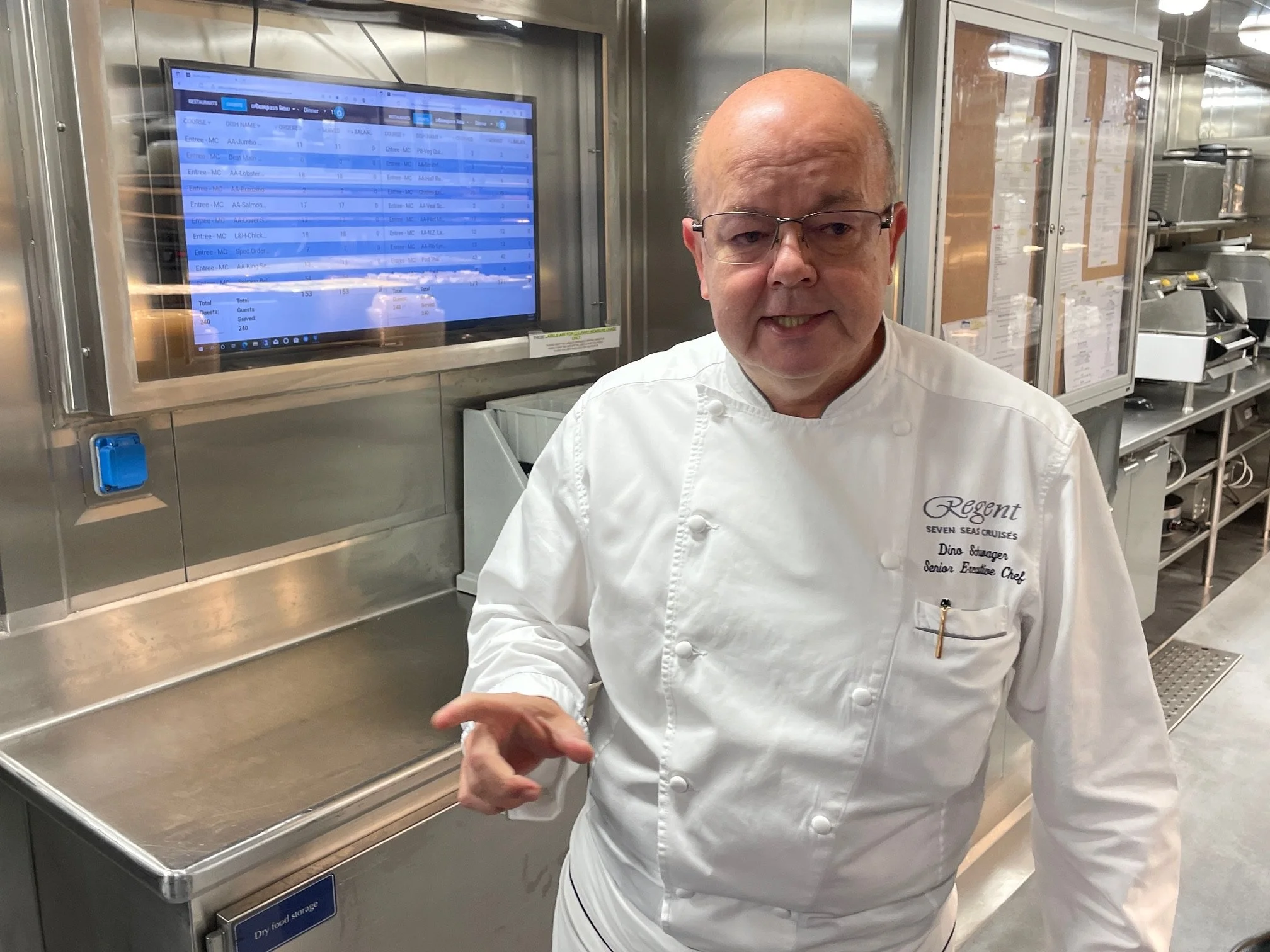
Senior Executive Chef Dino Schwager in his high tech galley
The guest chef, Christopher Gross, owner/chef at Christopher’s in Phoenix, finally got a chance to shine on the second last day of the cruise. On stage with overhead TV cameras focusing on the food, he carefully prepared a complex Parnassienne au Chocolate, a chocolate mousse tower covered by a dark chocolate lattice. It became a popular dessert feature at Compass Rose in the evening. Chef Gross was entertaining and very skilled but we, like many guests, were hoping he’d have even more culinary techniques and advice to share. He even told us he wished the ship had kept him busier.
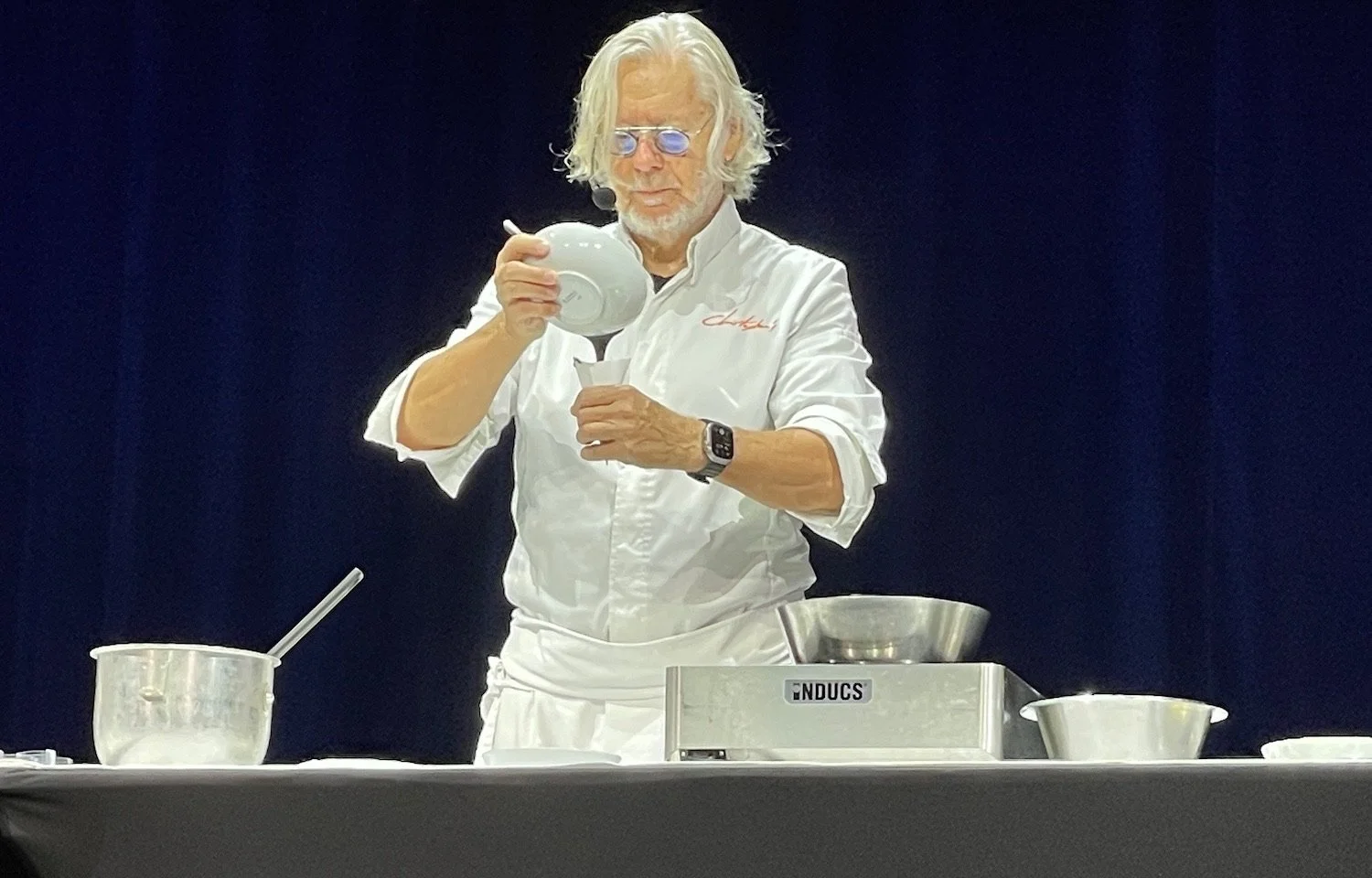
Guest Chef Christopher Gross prepares his chocolate dessert
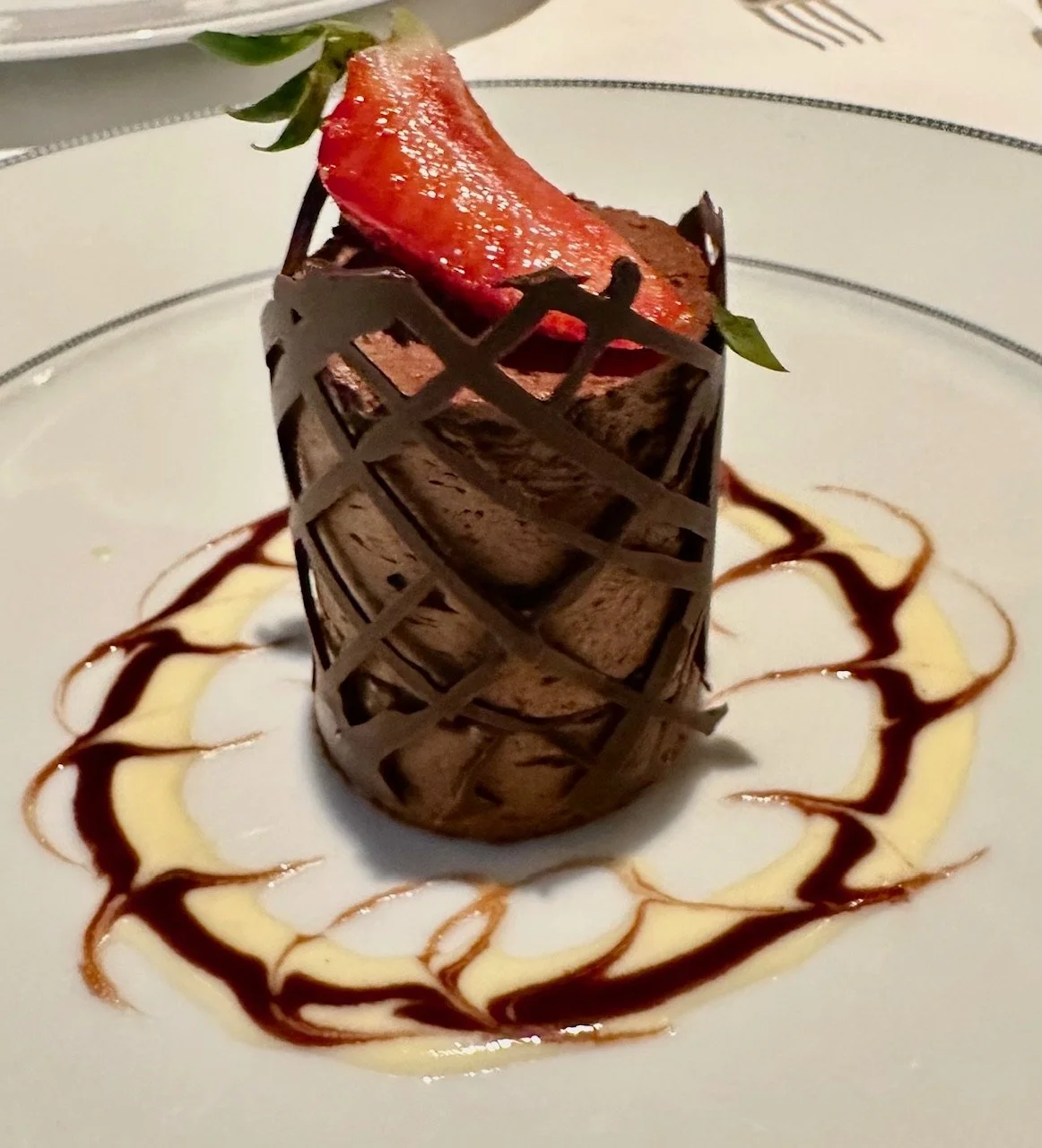
The chocolate mousse tower prepared by Chef Gross
The cooking presentation was in the 750 seat Constellation Theatre, the main showplace on Seven Seas Grandeur. Taking up decks 4 and 5 at the front of the ship, the comfortable theatre featured lectures and other presentations during the day and entertainment each evening. We were very impressed by the seven-piece band that accompanied most acts. The main performances involved eight resident dancers and four singers with complex shows on three separate nights. The dancers were great, the singers less so. One solo act stood out. Nik Page, a veteran West End performer, had a range of four octaves and received standing ovations for his energetic versions of hit songs from Les Misérables and Phantom of the Opera.
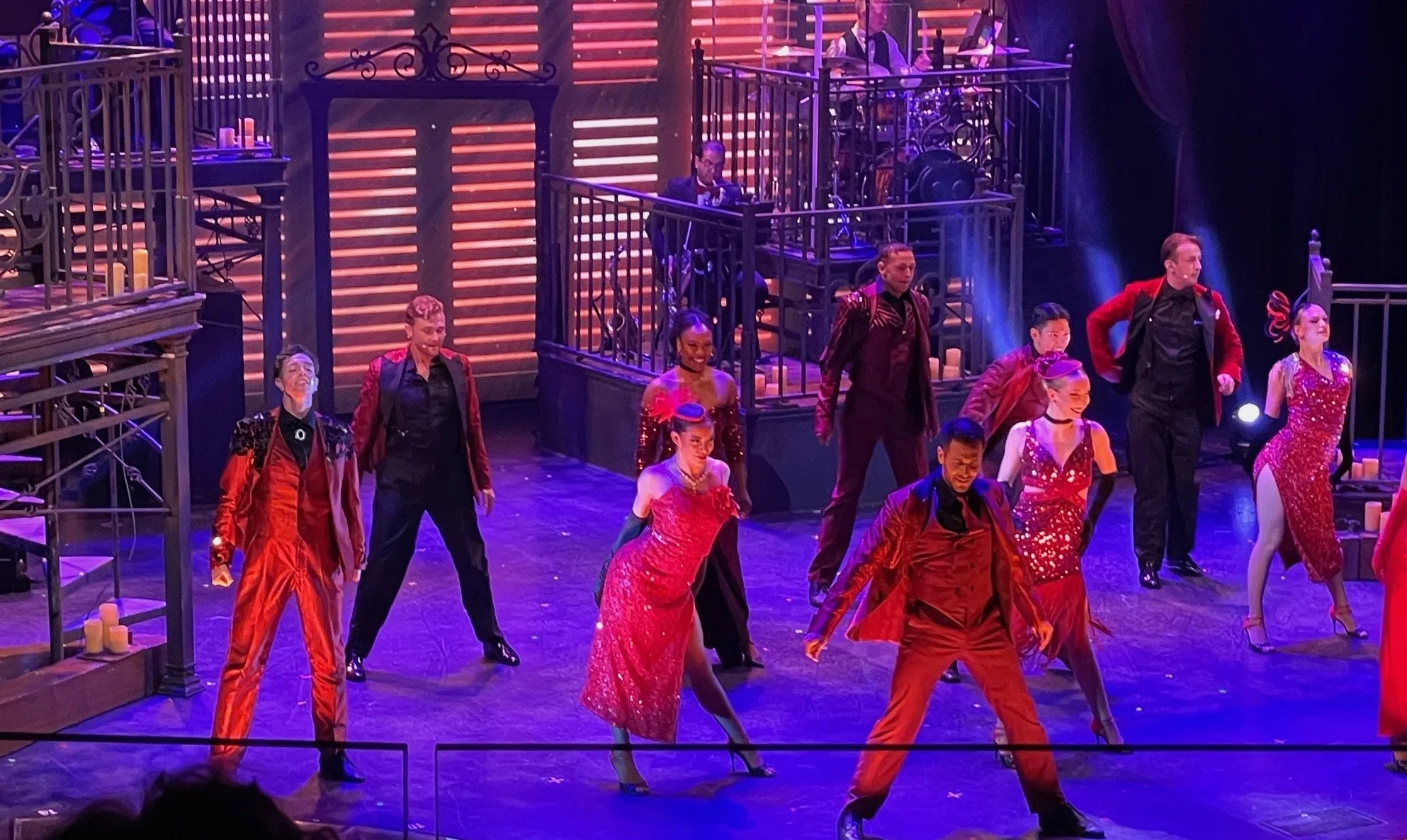
Imaginative shows in the Constellation Theatre
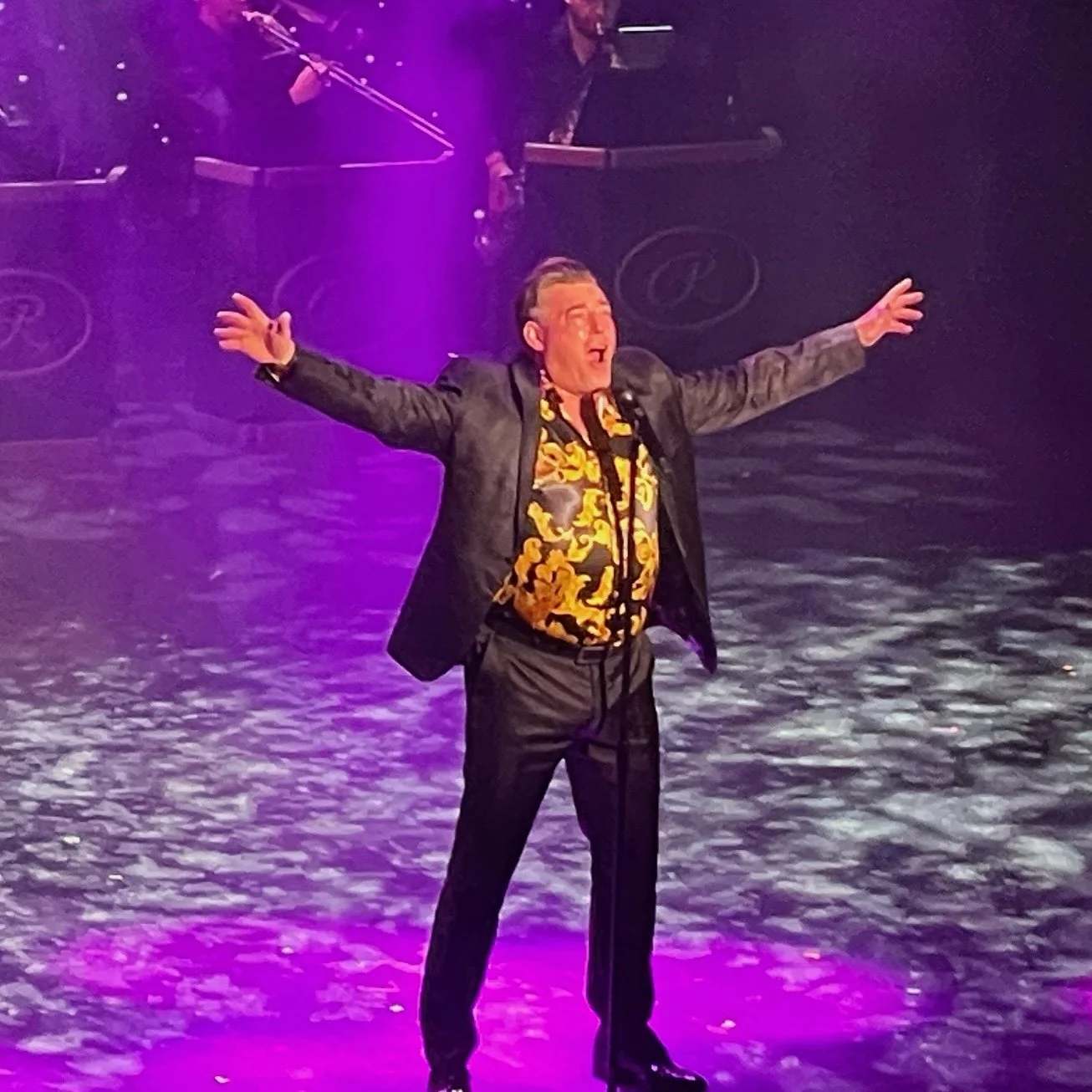
Nik Page
We’re always sad when a cruise of this quality comes to an end. But with the marvelous cuisine on Seven Seas Grandeur and the well-organized tours to Scottish castles, battlefields, archaeological sites and distilleries, we did learn much more about the history and culture of this unique and rich area of our planet. Our one regret was that the chefs chose not to prepare and serve traditional haggis, Scotland’s national dish.

John and Sandra Nowlan are travel and food writers based in Halifax.
Photos by John and Sandra Nowlan

A Mississippi River Cruise with American Cruise Lines
A Mississippi River Cruise with American Cruise Lines
We sailed down the lower Mississippi River with American Cruise Lines
By John and Sandra Nowlan
We knew there’d be some great music as we sailed down the Mississippi from Memphis on one of American Cruise Lines new, modern riverboats. We didn’t expect the Southern food and hospitality to be so good nor, as Canadians, to appreciate American history and culture so much.
The music began as soon as we entered the Memphis airport shuttle bus. The unmistakable voice of Elvis Presley singing “Love Me Tender” drifted down the aisle from hidden speakers. The bus Shaked, Rattled and Rolled as it took us to the Guest House at Graceland, a four star, 450 room hotel adjacent to Elvis’ Graceland mansion. American Cruise Lines offers guests an optional two night stay at the comfortable Guest House with free access to the mansion and the separate, vast collection of Presley airplanes, cars, motorcycles, costumes and gold records. We could see why the Graceland complex is the most visited private home in the United States.

Walls filled with Elvis performance outfits
En route to the riverboat, the cruise line gave us a bus tour of Memphis with stops at Beale Street (home of the Blues), Sun Records (where Elvis made his first recordings) and the Lorraine Motel (now part of The National Civil Rights Museum) where Dr. Martin Luther King, Jr. was assassinated in 1968. We felt a strong sense of sadness as we gazed at the balcony of Room 306.
Our first glance of our Mississippi riverboat was from atop a levee in Memphis. We headed down the steep ramp to board the American Melody through its unusual flipped-up bow. Riverboats on the Mississippi have a unique challenge. With flood-control levees, some as high as 50 feet, all along the Mississippi, American Cruise Lines always carry golf carts to help the elderly and infirm safely navigate the challenging slopes.

Am Melody Ready To Board Passengers
In 2018 American Cruise Lines, the largest river and small ship cruise line in the United States, introduced the first modern riverboats in North America. American Melody was built in Maryland in 2021 with a maximum capacity of just 175 guests and an average room size of 350 square feet. Our “Veranda Suite” was 405 square feet and felt more like a spacious hotel room but with better, ever-changing views. We particularly appreciated the comfortable, king size bed and luxurious sheets and pillows. There were plenty of power and electronic outlets, high quality internet, much more drawer space than we’d ever need, very efficient temperature control, a 50 inch TV, and a large bathroom with soft, fluffy towels and two separate nozzles in the shower. We weren’t surprized when we were told that the ACL fleet of 20 riverboats (operating in 35 states) has the largest average guest rooms of any cruise line.

With the failure of American Queen Voyages, the only current competition for American Cruise Lines on the second longest river in the U.S. (the Missouri is about 100 miles longer) is the Viking Mississippi. This cruise ship is much larger than the ACL boats, accommodating up to 386 guests. The Hotel Manager on American Melody told us that the smaller boats of his company are better suited for the Mississippi because occasional low water levels can prevent the bigger, deeper draft of large boats from operating. American Cruise Lines riverboats have never missed a scheduled sailing due to water depth.
Finally heading downriver with a full passenger load (mostly Americans but with a smattering of Canadians, Brits and Australians) we were impressed with the layout of American Melody. Its four story atrium and public rooms never seemed crowded. On Deck 3 forward the large bright River Lounge was used for port briefings, trivia, excellent enrichment lectures and entertainment. The smaller indoor/outdoor Sky Lounge at the back of Deck 4 was a snackers dream, offering freshly baked cookies, 24 hour snacks, a wide selection of drinks, excellent coffee and made-to-order breakfast sandwiches. Plenty of loungers and a wrap around walking track were available on the full length top deck so guests could enjoy the passing scenery, including heavily laden barges pushed by strangely-named tow boats, semi tropical vegetation and small communities. When we reached Baton Rouge, heavy industry tended to dominate the shoreline.

Relaxing on back deck
Meals were a special treat on American Melody. As expected, emphasis was on Southern U.S. dishes, especially Creole, Cajun, even a noontime pig roast. We loved our Cornmeal Crusted Catfish with Collard Greens, Gulf Coast Blue Crabcakes, Sea Bass with Sauteed Crawfish and Jambalaya. The fish was particularly tasty. The Hotel Manager told us all seafood is fresh, never frozen. Lunch and dinner included complimentary wine, beer and spirits as well as a good selection of non-alcohol beer and wine. In the evening, white tablecloths graced the tables.

Cornmeal crusted catfish with collard greens
The serving staff on American Melody was young and energetic. By U.S. law, all staff must be American because ACL riverboats do not visit a foreign country. Although friendly and well-meaning we found the restaurant staff to be less efficient and well-trained as the primarily Filipino and Indonesian staff on international river, lake and ocean ships. Hotel Manager Glenn Taylor told us that while his staff may not be as polished as the international competition, they’re always pleasant and accommodating. He added that this is often the first full time job for young servers and he’s delighted that so many have used the riverboat experience as a stepping stone to a career in hospitality.
We were impressed with the quality of evening entertainment on American Melody. The talented performers were better than musical acts we’ve enjoyed on many European river cruises. Our favorites included Mississippi Marshall, a master of the Blues who played a mean guitar (we bought his CD), Chris Gill and the Sole Shakers (a three man band with female vocalist) and the Banjo Cats, a husband and wife team who have mastered several instruments.

The Banjo Cats
The tours (most were complimentary) were outstanding. Who knew that tiny Cleveland, Mississippi, is the home of the impressive Grammy Museum, highlighting the amazing musical talent in southern states and around the Mississippi Delta? A stop in Vicksburg allowed us to visit a private Civil War museum with its huge collection of artifacts from that troubled time as well as the unusual Coca-Cola Museum in the building where Coke was first bottled in the U.S.
In Vidalia, Louisiana we visited a cotton plantation where we were able to hand pick some fluffy cotton, explore a historic cotton gin, then observe in a modern cotton gin the process of cleaning and bundling in 500 pound bales for transport. Along the way we were also able to visit several southern antebellum mansions that resembled a scene from Gone With the Wind. Standouts were The Myrtles in St. Francisville, Louisiana, and Oak Alley in Vacherie, Louisiana.

Oak Alley antebellum mansion in Louisiana
Our highlight in Baton Rouge, Louisiana, was a visit to the capital building that dominates the skyline. At 450 feet it’s the tallest state capital in the United States. The panoramic view of the city and meandering Mississippi from the observation deck is spectacular. Built in the early 30s during the Depression, it was a project masterminded by controversial Governor and then Senator Huey Long. He was assassinated inside the building in 1935 where there’s now a memorial. We ended the day relaxing on our balcony admiring a magical pastel sunset.
Louisiana is well known for its plentiful bayous, slow moving marshy waterways. On our last day aboard American Melody we signed up for a tour called, “Cajun Pride Swamp Adventure”. Adventure indeed! Aboard a 40 passenger, flat-bottom aluminum boat, our captain took us through the narrow bayous where alligators were plentiful, either lounging on the shoreline or swimming alongside us (our captain even fed a few without losing his hand). In addition, we met many playful racoons and a family of not-so-playful wild hogs.

A small alligator on the Cajun Pride Swamp Adventure
The guest mix aboard American Melody was interesting. The personable and efficient Cruise Director, Colin Hietikko, told us that many of his American guests had traveled the world in their younger years and now wanted to stay closer to home with something safe and accessible. Older couples were certainly the prime demographic on our cruise with an average age of more than 70. But Glenn Taylor, the hotel manager, said that was slowly changing as the modern, all-inclusive riverboats in the American Cruise Lines fleet were beginning to attract more young people. That, along with fascinating itineraries, is a recipe for continued success.

Caviar for Breakfast. A Regent Ultra-Luxury Cruise.
By John and Sandra Nowlan

Seven Seas Splendor docked in Cozumel
As much Atlantic Canadian lobster as you want. Prime filet mignon on the menu each night. Unlimited caviar at Sunday brunch. Just three of the culinary indulgences on a cruise line with the motto, “Luxury Refined”.
Regent holds a unique place in the world of cruising. The high end brand of parent Norwegian Cruise Line, its five ships are in the rarified ultra-luxury category but Regent stands out by offering a complete all-inclusive package. Included in the price are a spacious suite with balcony, all meals (including specialty restaurants), drinks (including beer, wine, spirits and cocktails), tours (with a wide variety of choices in each port), gratuities, airport and hotel transfers, even laundry and pressing. In some categories first class flights and pre-cruise hotels are included.
Janice Davidson. Regent’s VP for Creative and Brand Management, told us her greatest marketing challenge is price. “We’re trying to educate people about what comes with all inclusive,” she said. “With our single up front cost, guests could actually pay less than on other lines.”

The “Welcome Aboard” Champagne
As soon as we boarded Seven Seas Splendor, Regent’s newest ship, for a week long Caribbean cruise from Miami the luxury and service stood out. Walking around with welcome champagne in hand, the 46,000 square feet of fine Italian marble on walls and floors and more than 500 stunning chandeliers created an ambience unlike any we’ve experienced in 25 years of cruising. The ship, launched in 2020, has a capacity of just 750 guests, all in balcony suites ranging from an impressive 307 to more than 4000 square feet. The crew of 550 provides the best staff to guest ratio at sea. Their friendliness, training and attention to guest needs were evident all week.

Italian marble throughput the ship. The entrance to the main restaurant
We were in one of the smaller suites but were impressed with the layout and generous storage spaces including a walk-in closet. The long couch and convenient work desk were separated from the bed area by privacy blackout curtains while the balcony with its generous table and two cushioned wicker chairs was one of the largest we’ve ever seen. The bed itself was extremely comfortable with high thread count sheets and excellent adjustable reading lights. There were several convenient USB and power outlets. The thermostat was controlled by up and down – warmer and cooler – arrows rather than an actual temperature setting. The small fridge could be filled with whatever complimentary drinks we wanted. The marble lined bathroom had just one smallish sink but a large shower area with both a regular shower head and a rainforest-style shower.
Our suite was near the back of the ship so we could occasionally hear engine rumble, especially when getting underway or docking. But we think the general room soundproofing is excellent since the ship was full and we didn’t hear a sound from any of our neighbors.
Rooms are cleaned and refreshed twice a day with newspaper summaries (from the USA, Canada, Britain and other countries) put on the bed each evening along with tomorrow’s schedule (the spacious library includes a daily, full edition of the New York Times). The large, high resolution TV had many free movies available but broadcast channel choices were very limited.
One negative aspect of not just the suites but throughout the ship was the poor internet service. Regular, free but slow internet is available for all guests. We booked the premium, extra cost package but it was only marginally better. Email and YouTube worked fairly well but posting photos on Facebook was not possible. The technical head on the ship told us that satellite improvements are coming.
Regent continues to excel in its culinary program. The Hotel General Manager, Anatoli Makaev, told us that food costs, per person, are the highest at sea. Regent, he said, is spending three times more for food than before the pandemic. Unlike other lines, there have been no cutbacks in quality or quantity. Chefs continued to get paid during the Covid years and their commitment to guest satisfaction is evident.

Decadent desserts in the buffet
For a ship with fewer than 800 passengers, the restaurant and menu choices were remarkable. Every evening in the main dining room, Compass Rose, guests could choose from an “Always Available” menu (from Alaska Crab to New Zealand lamb) or the daily specials including the Executive Chef’s six course “Gourmet Tasting Menu”. A healthy Spa menu was also available. Good quality red, white, rosé or sparkling wines were offered without extra cost each day, even non-alcoholic wines if you wished. Three uniquely decorated specialty restaurants offer French cuisine (Chartreuse), Asian fare (Pan Pacific) or Steaks and Seafood (Prime 7).

Alaska crab appetizer in the main Compass Rose dining room
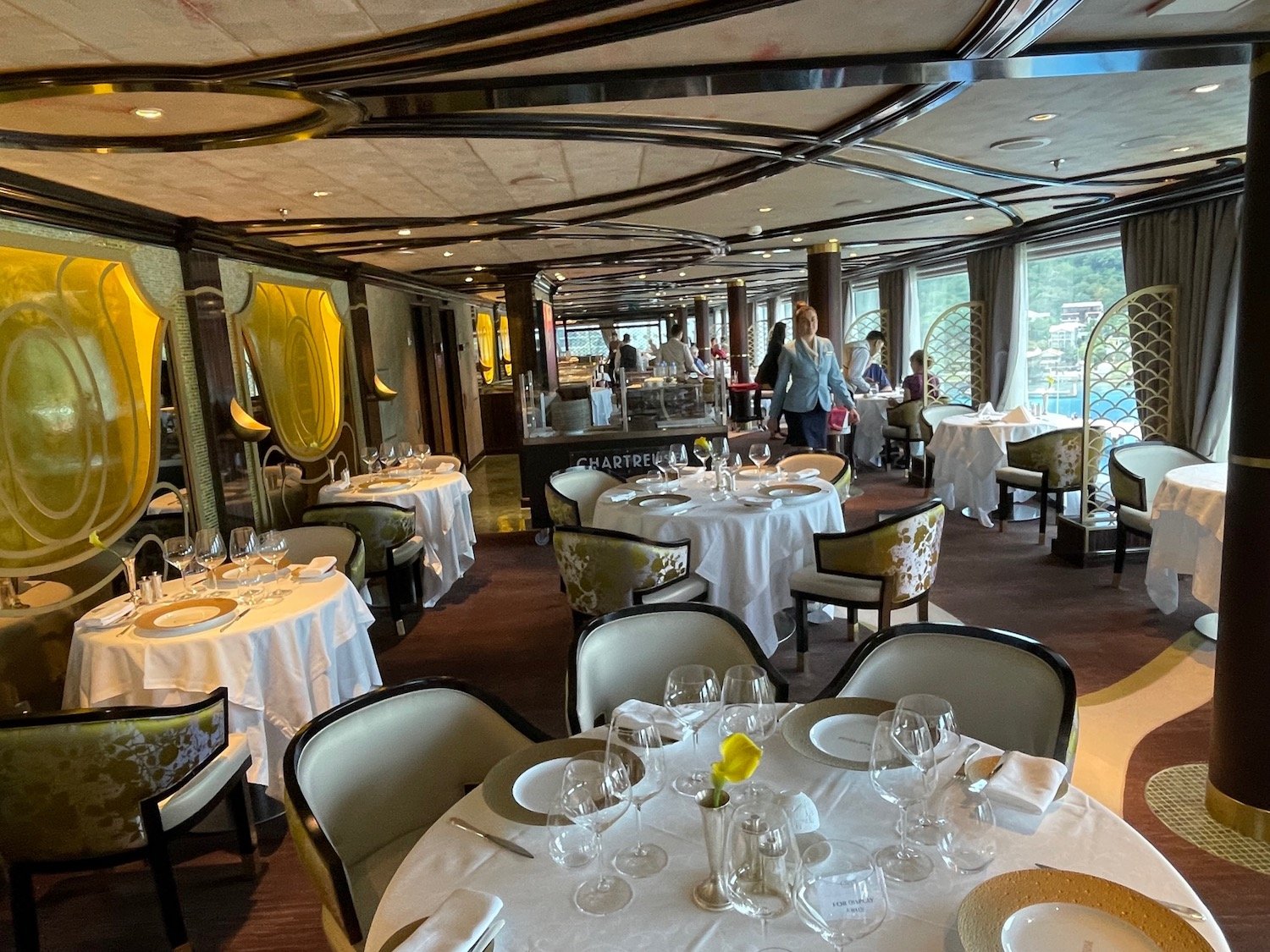
The Chartreuse French specialty restaurant
The large buffet restaurant on Deck 11, La Veranda, has an excellent selection of breakfast and lunch items. White tablecloths are standard throughout the area (most unusual for a cruise ship buffet) and are a classy touch in the evening when much of La Veranda becomes a fine Italian restaurant, Sette Mari. Coffee quality in the buffet was only fair but outstanding brews were always available at the 5th deck Coffee Connection.

The uncrowded buffet restaurant
Seven Seas Splendor has a well equipped fitness center and a Spa at the stern of the ship. We discovered the uncrowded Infinity Swimming Pool as part of the Spa and preferred it to the large, main pool on Deck 11.

The Infinity Pool at the stern of the ship

The well equipped gym
Splendor’s entertainment was, as expected, of a high caliber with a dozen talented singers and dancers, accompanied by the ship band, putting on several complex main stage productions in the evening. The Regent Signature Orchestra, the Cocktail pianist and a DJ also played music for listening or dancing each evening in several lounges throughout the ship. On our final evening a few band members and singers put on a lively Beatles music night, with dancing encouraged, in the Atrium. We were disappointed that the ship’s entertainment did not include a string quartet or even a solo cello or harp. Classical music would have been a lovely touch in the pre-dinner period.

Curtain call after an imaginative main stage production
There was no shortage of games and puzzles throughout the ship. Trivia, Bingo, darts, shuffle golf and beanbag toss were among several ways guests competed for coveted Regent points and prizes at the end of the cruise. We were also pleased to see and hear a retired history professor give illustrated lectures about subjects ranging from Mayan civilization to the Caribbean connection in World War II. Another special treat was seeing actor John O’Hurley (best known as J. Peterman on Seinfeld) perform his brilliant one man show – music and musings – called “A Man With Standards”.

Excellent history lectures in the main theatre
The ship itself was clearly the star of our week-long cruise from Miami but the itinerary was fascinating too. We docked in Roatan, Honduras, for an island tour and swim, then stopped the next day in nearby Belize, the only English speaking country in Central America. Sandra joined a tour to a spice farm where the two chefs from the Culinary Arts Kitchen collected spices to be used in a hands-on cooking class back on the ship. Guests prepared prawn biryani with garam masala and white pepper crepes with cardamom ice cream. In the meantime John visited a typical Mayan village off the grid where a chocolate maker showed how cacao beans were harvested and turned into the popular sweet treats.
Our planned stop in Costa Maya, Mexico, was cancelled because seas were too rough to dock but Cozumel was more tranquil and we relived our youth by boarding a two-person mini speedboat and racing through choppy water with other boats before stopping for a snorkel in warm, pristine waters filled with tropical fish.
Seven Seas Splendor has been called, “the most luxurious cruise ship in the world”. In many ways it’s true. But later in 2023, Regent is launching Seven Seas Grandeur, a sister ship to Splendor. With subtle improvements, Grandeur is now likely to claim the “most luxurious” title. It will be fun to find out.
John and Sandra Nowlan are travel and food writers based in Halifax.
Photos by John and Sandra Nowlan

Hurtigruten…The World’s First Hybrid Cruise Ship
Travel and food writers, John and Sandra Nowlan spend seven nights aboard Hurtigruten’s Roald Amundsen.
By John and Sandra Nowlan
Expedition cruising puts its emphasis on smaller ships visiting isolated and unusual locations. Instead of casinos and entertainers, a team of scientists and historians provide daily briefings and analysis. Hurtigruten, with a long history of Scandinavian coastal service, has now become a significant and innovative player in the growing trend towards Arctic, Antarctic and exploration in remote regions.

Hurtigruten’s Roald Amundsen in Halifax Harbour preparing for its seven day sail to Boston
Launched in Norway in 2019 with a maximum of 530 passengers, Hurtigruten’s Roald Amundsen is the world’s first hybrid powered cruise ship. Named for the intrepid Norwegian explorer of both north and south polar regions it uses four Rolls Royce designed diesel engines (one is a spare) but is always connected to two large banks of rechargeable batteries. Emissions are lowered and fuel savings can reach 20%.
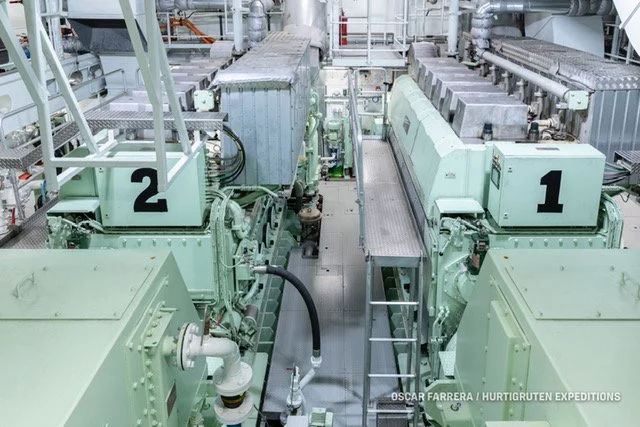
Hybrid Power Plant - Photo Courtesy of Hurtigruten Expeditions
John and Sandra Nowlan preparing to board the Roald Amundsen in Halifax
When we joined the ship in Halifax after its first leg from Nome, Alaska, Roald Amundsen was several weeks into a unique cruise from Alaska and Canada’s Arctic all the way south to Antarctica. With just 260 guests, the ship began an unusual seven day cruise to Boston
All newcomers were given complimentary, bright red waterproof jackets and were fitted for boots. Our itinerary was fascinating – a stop at remote Sable Island, then back to mainland Nova Scotia and the UNESCO World Heritage fishing port of Lunenburg, then visits to three towns in Maine, followed by Cape Cod and finally Boston. Twenty avid cruisers did not disembark in Halifax but chose to stay on the ship for the complete Arctic to Antarctic itinerary. The 157 crew members - Norwegian officers, naturalists from several countries and most service staff from the Philippines - welcomed the new guests, a mixture of American., German and British cruisers. Announcements were in English and German.
The Roald Amundsen, with its distinctive black, white and red livery, is impressive. The interiors reflect modern Scandinavian design with an abundance of natural materials – wood, granite, wool and linen – creating stylish and comfortable cabins and public areas. All cabins have ocean views but there are 83 rooms with balconies and 53 suites.
All rooms are comfortable and well equipped. The complimentary wi-fi signal was usually excellent in rooms and throughout the ship. Our suite had a walk-in closet with plenty of storage space. The king bed was particularly luxurious with twin duvets, silky sheets and excellent lighting. Guests are offered bath robes and slippers in various sizes (a rarity on any but the most high end cruise ships). There are plenty of electric outlets but all are European Style (round prong) so adapters are needed. There’s a coffee maker and a fridge stocked with beer, soft drinks, sparkling water and wine. Paper and plastic are virtually eliminated on the ship and all guests receive a complimentary aluminum water bottle with refill stations on every floor. The Hotel Manager told us that Hurtigruten aims to be the most sustainable shipping company in the world.
A standard, oceanview room on Roald Amundsen
One of 83 balcony cabins, featuring artwork chosen by the Queen of Norway
Our room had an impressive 50 inch, LED television with limited news channels (MSNBC and Fox from the US with Sky News and BBC from the UK) but the Atrium Lobby has a tall television that hugs a wall for seven full stories with continually changing scenes from nature. The “Boot Room” also had a huge horizontal TV with colorful scenes from Hurtigruten adventures. Impressive! Traditional Norwegian art (with many woodcuts) is found throughout the ship, much of it chosen by HM, the Queen of Norway, with several from her personal collection.
The British Executive Chef on Roald Amundsen was a former Michelin-starred restaurant owner. David McDonald’s cuisine was generally excellent in all three restaurants and the complimentary wine at lunch and dinner was of high quality.
Aune, the main dining venue, seats 240 at blond, wooden tables and features many areas for just two guests in a bright, attractive setting. For all meals (breakfast and lunch buffets and a la carte dinners) the Maitre ‘D records your room number and assigns a table when you enter the dining area. Very progressive! High tech has replaced traditional paper menus and guests are expected to order their meals from the Hurtigruten app. Everyone seemed to be equipped with a smart phone, so there was rarely a problem.

Main Dining Room
Fredheim is an informal corner for stylish street food. The diner atmosphere works well for an array of burgers, fries and sausages but also Asian dumplings, tortillas, waffles, crepes and a crab roll. Fredheim also offers tall, creamy milkshakes, the best we’ve ever had at sea.

Best Milkshakes at Fredheim Restaurant
The full service restaurant is called Lindstrom. Designed for suite guests, others can enjoy the exemplary service and extra perks for 25 Euros a person. The lamb and bison dishes were especially tasty.
The only disappointment with dining during our week on Roald Amundsen was its lack of any East Coast seafood. Even though we started in Halifax and stopped in several important Atlantic fishing ports, the only seafood offered was from Alaska and the West Coast. We were told there were communication problems with the European head office (this was Hurtigruten’s first visit to Nova Scotia) but for repeat cruises in 2023 and 2024, the fresh fish problem will be investigated and resolved.

There’s a walking track and gym equipment on the top deck
Hurtigrutan, with its six expedition ships (two of which are now hybrid), may not appeal to everyone. There’s no casino and no traditional evening entertainment (there is a piano in the Roald Amundsen’s main lounge, but no resident pianist). The emphasis, which we and most guests relished, was on science and learning. The Amundsen Science Center, taking up major space on Deck Six, is rich in resources with a science library, maps, illustrations, a large, interactive touch table, artifacts like skulls and walrus tusks and the prime attraction, a series of specialized Zeiss binocular microscopes, one of which is connected to a large screen TV. Seven scientists, covering a wide range of specialties, often gathered seashore specimens like tiny copepods and gave illustrated lectures each evening in addition to talking about our next port.

Hurtigruten’s team of scientists give nightly lectures on a variety of subjects
Expedition ships, with their non-traditional ports of call need to be flexible. Landings on Sable Island, a Canadian National Park Reserve located 190 miles east of Halifax, have to be made by zodiacs. Unfortunately the Atlantic Ocean was just too rough the day we arrived. Instead, the captain gave us a full circumnavigation of the 27 mile long sand bar where, with binoculars, we could see the wild horses and thousands of gray seals. The weather the next day was perfect in Lunenburg and most guests visited the large and outstanding Fisheries Museum of the Atlantic.

The popular Amundsen Science Center features high end microscopes and a staff of naturalists
Maine weather was variable but, in spite of the rain, most guests got off the ship when it was docked in tiny Eastport, next to the Canadian border. This easternmost ‘city’ in the US used to be the sardine capital of the world. Rockland, Maine, required a tender transfer to port but, with bad weather, many guests stayed aboard. Bar Harbor, a popular stop for tradition cruise ships, gave guests on the Roald Amundsen the opportunity to visit Cadillac Mountain (tallest mountain on the east coast of the US) and the rugged seascapes of Acadia National Park, the first national park east of the Mississippi.
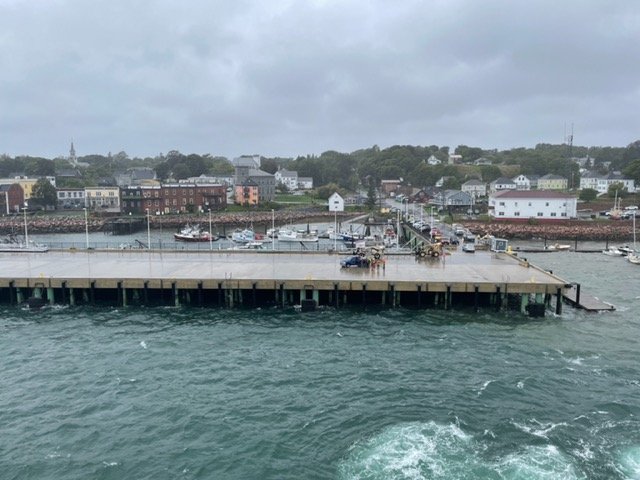
Stormy weather. Roald Amundsen approaches the easternmost ‘city’ in the US, Eastport, Maine
More bad weather made a visit to Cape Cod impossible and, with Hurricane Fiona churning up the Atlantic, the captain made a wise choice to head for Boston early for an extra overnight. On schedule the next day, most guests headed home from Boston but a couple of dozen of us stayed overnight at Hurtigruten’s recommended hotel, the elegant and historic Fairmont Copley Plaza. Now celebrating its 110th anniversary, it was ideal for connecting to our 90 minute morning flight back to Halifax. And, missing Atlantic seafood on the Roald Amundsen, the lobster roll at the Fairmont’s Oak Long Bar + Kitchen was fantastic.

Final Night in Boston at Fairmont Copley Plaza
With expedition cruising becoming very popular, Hurtigruten is planning to repeat its North-South and unique Halifax to Boston itinerary in 2023 and 2024. As the line refines its excellent product, the route should be a huge hit, especially for those cruisers wanting more than a traditional cruise. One guest from Houston had started her cruise in Alaska and was delighted. “We have a new appreciation of the diversity in Canada”, she told us. “Thanks to the excellent expedition team, we learned a lot about environmental input and indigenous culture. The ship is a great size and we don’t miss the casino or Broadway shows one bit.”
John and Sandra Nowlan are travel and food writers based in Halifax.
Photos by John and Sandra Nowlan

Sea Cloud, History and Tradition in the Caribbean
According to the Berlitz Cruise Guide, Sea Cloud is “the most beautiful cruise-sail ship in the world…and one of the world’s best travel experiences.”
By John and Sandra Nowlan

Sea Cloud Under Full Sail
According to the Berlitz Cruise Guide, Sea Cloud is “the most beautiful cruise-sail ship in the world…and one of the world’s best travel experiences.”
What makes this 60 passenger square-rigger, now almost 90 years old, even more interesting is when the cruise starts and ends in Barbados. This tropical paradise, very popular with Americans and Canadians, is the ideal location to begin one of Sea Cloud’s regular Caribbean itineraries. The friendly, former British colony is blessed with some fine beach hotels and excellent restaurants. We stayed at a resort that combines both. The Fairmont Royal Pavilion is located on a superb stretch of sand with every room overlooking the turquoise Caribbean. Fairmont’s enhanced culinary focus has made it even more attractive, especially the new steakhouse, Palm Terrace, with some of the best beef we’ve ever enjoyed.

The Beach at the Fairmont Royal Pavilion
It’s a 20 minute taxi ride to the busy Barbados cruise port in Bridgetown, the capital. Three big cruise ships were tied up but the vessel that stood out was our sleek windjammer, Sea Cloud. The tallest of its four masts rises 184 feet above the waterline. The sails were tied up, of course, but the eight miles of hemp ropes and rigging evoked another era.
Marjorie Merriweather Post's Bedroom on Sea Cloud.
Sea Cloud was built in Germany in 1931, a gift from U.S. financier Edward F. Hutton to his wife, cereal heiress Marjorie Merriweather Post, the richest women in America. At the time it was the largest private yacht ever built with no expense spared for teak decks, burnished brass and furnishings in mahogany and elaborately carved oak. The two master bedrooms, filled with Chippendale furniture, were huge with marble fireplaces and ornate gold faucets in the bathroom.
Sea Cloud has gone through many changes over the years including time as a weather observation ship in World War II. In 1979 a group of German investors bought the ship, spent $7.5 million refurbishing it and making it available for charters and scheduled itneraries. Further enhancements added more cabins and modern safety features.

The Nowlan's modest room. Small, but comfortable. Two large windows.
Sea Cloud can now accommodate 64 guests in a wide variety of cabins. The eight ultra-luxury suites are on the first deck with the remainder on decks two and three being modest in size (our room had narrow, twin beds) but with quality furnishings and excellent L’Occitane toiletries in the generously sized bathroom. There are no televisions but internet is available and each day a newspaper summary is delivered to staterooms.
Many of the efficient and friendly crew of sixty are used for constant maintenance and for setting the 29 sails. It’s a stunning spectacle to see the young men and women climbing up the rope ladders to the topmost sails where they untie the lines, then return to deck to wrestle and tug on the coils of rope which unfurl the vast expanse of billowing sheets. Several times each voyage, guests are invited to .help with these latter stages (guests are not allowed to climb the masts).

Crewmembers climb the masts to set the sails.
Outstanding cuisine is a highlight of every Sea Cloud cruise. Buffet lunch, often with fresh fish or lobster brought aboard at various ports, is carved, grilled and served on the Lido deck. There’s an adjacent bar with an excellent array of complimentary spirits, wine and beer. There were at least ten Scotch choices including high end single malts like Talisker, Dalwhinnie and Oban.

The chef brings fresh fish aboard for lunch.
In the evening, elegant meals are served in the original lounge (one wall is a fine library) and adjacent dining room where the rich and famous dined and were entertained in the 1930s and 40s. Surrounded by dark woods, hand carved mahogany and oak plus nautical oil paintings, guests are pampered with fine wines and extraordinary cuisine like duck breast, rack of lamb, tender filet of veal or black halibut. We counted more than 20 different cheese choices during the cruise. The galley is small but the quality of the output is remarkable.

The ornate Sea Cloud Dining Room.

Lunch Buffet, overseen by the genial Hotel Manager.
Entertainment on Sea Cloud is minimal (no one missed the big production shows) but a pianist plays each day, a knowledgeable historian gave lectures about the islands we were visiting, an officer talked about star gazing (visibility at night is excellent, of course), a local band was brought aboard one evening and, as a highlight, the crew assembled in traditional sailor’s outfits to sing sea shanties.

Local Entertainers are invited on board Sea Cloud.
Our Barbados round trip itinerary was a treat. It included Bequia in the Grenadines where we boarded safari trucks to tour the island and visit a sea turtle rehabilitation centre. After a relaxing sea day we docked in Dominica by Cabrits National Park where local historian Dr. Lennox Honeychurch showed us nearby Fort Shirley and the work he’s done to restore the British garrison, built in 1765 to deter the French.
A short visit to St. Barths with its fancy yachts and high end shops was followed by a fascinating tour of Virgin Gorda in the British Virgin Islands. The highlight was “The Baths”, a series of huge, volcanic seaside boulders with small, pristine beaches. Unfortunately the surf was too high for safe swimming. We were able to swim the next day at Iles de Saintes in Guadeloupe. The lovely beach alongside the village is filled with fishing boats and we could see the fishermen unloading their catch surrounded by hungry pelicans.

The Baths. Volcanic Rock Formations in Virgin Gorda.
Our last stop, Saint Lucia, was a particular delight. After anchoring in Soufriere Harbour close to the famous Twin Pitons, most guests took the complimentary tour which included the lush Diamond Botanical Garden and Waterfall plus the world’s only drive-in volcano (still bubbling and steaming, it was formed by a collapsed crater more than 400,000 years ago).

St. Lucia's Drive In Volcano. Always steaming.
We were reluctant to leave this remarkable and historic vessel once we returned to Barbados but we had booked a half day Lickrish Food Tour through the UNESCO listed center of Bridgetown. We’ve been on food tours in other cities but this was by far the most complete. Our entertaining guide was very knowledgeable about the history and culture of the city and took us to seven restaurants and food stands specializing in local Bajan cuisine like barbequed pig tails and spicy fish cakes. Generous portions for all.

The Twin Pitons and local St. Lucia Beer.
After the extraordinary food on Sea Cloud we really didn’t need more temptations but the Lickrish tour was a delightful addition to our unique Caribbean land and sea adventure.
John and Sandra Nowlan are travel and food writers based in Halifax.
Photos by John and Sandra Nowlan

Eurodam. Sailing south from Vancouver with great entertainment and excellent food.
“I guarantee you, we have the best live music at sea.”
By John and Sandra Nowlan
A possible exaggeration from Rubin Kooiman, the genial Hotel Director of Holland America’s 2100 passenger cruise ship, Eurodam. But with 11 days ahead of us, we were looking forward to seeing if his boast was valid.
In recent years, Holland America has evolved its live music program on several older ships and on its newest vessels, Koningsdam and Nieuw Statendam. The Music Walk is a series of Deck Two venues added to Eurodam in 2015 that run the gamut from hard rock to blues, from Top 40 to classical.
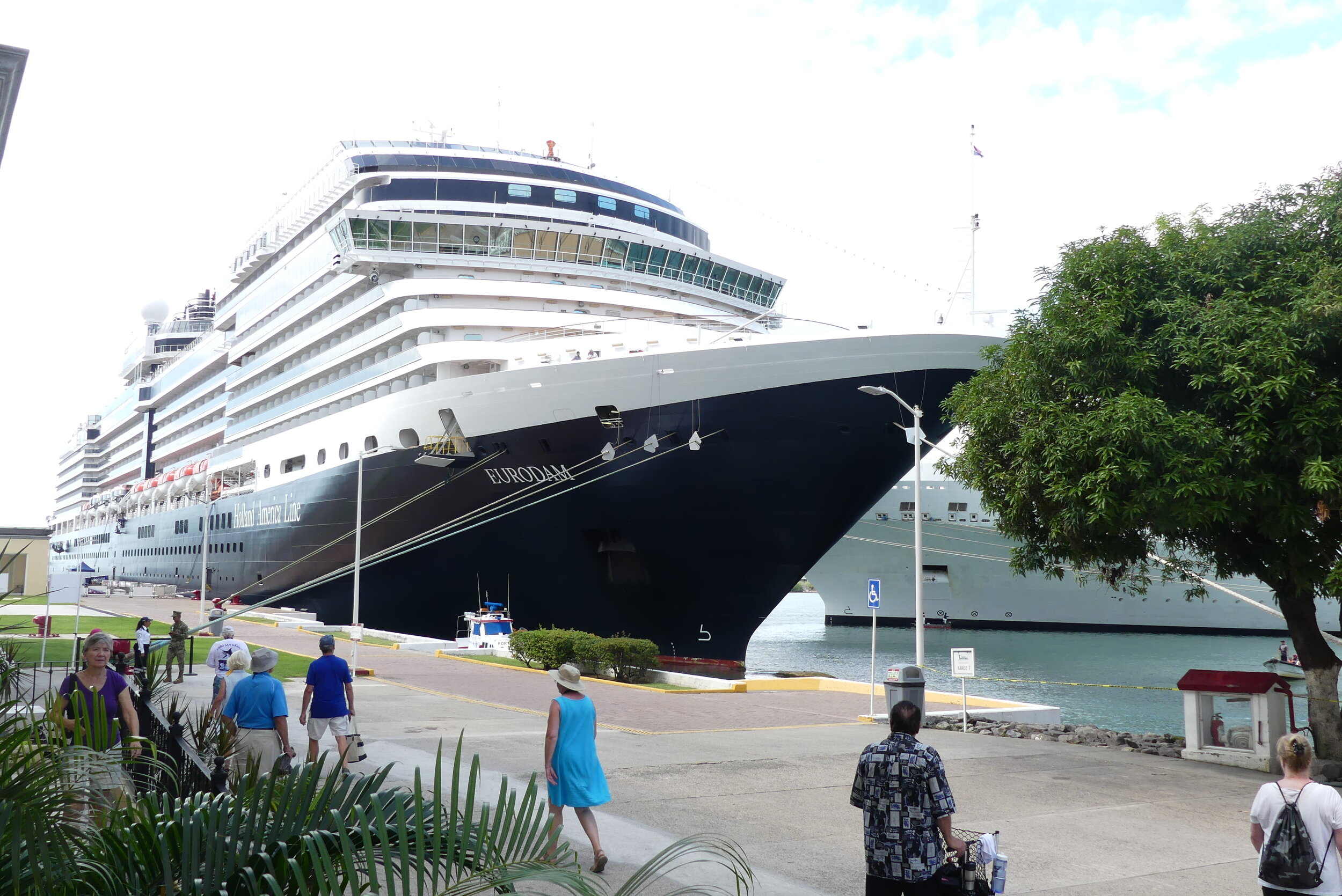
Eurodam Docked in Puerto Vallarta.
As on all large cruise ships, Eurodam, launched in 2008, has a main theatre where a team of talented dancers present several different Broadway-style productions each cruise with dazzling special effects from the background light curtains. On our cruise from Vancouver to San Diego, with three stops in Mexico, we also had main stage solo acts, usually from singers and pianists, accompanied by a live band.

Twin Pianos at Billboard Onboard.
But the Music Walk is what sets Holland America apart. Every evening there were several choices for live music, always with a large, appreciative audience. The loudest was the BB King’s Blues Club with a full band and soloists belting standards from the Blues repertoire. Next door was Billboard Onboard, twin pianos played by a pair of singers who know the Billboard charts through the decades and can handle almost any request. On the two newest, slightly bigger HAL ships there’s an additional venue for the high volume Rolling Stone Rock Room.
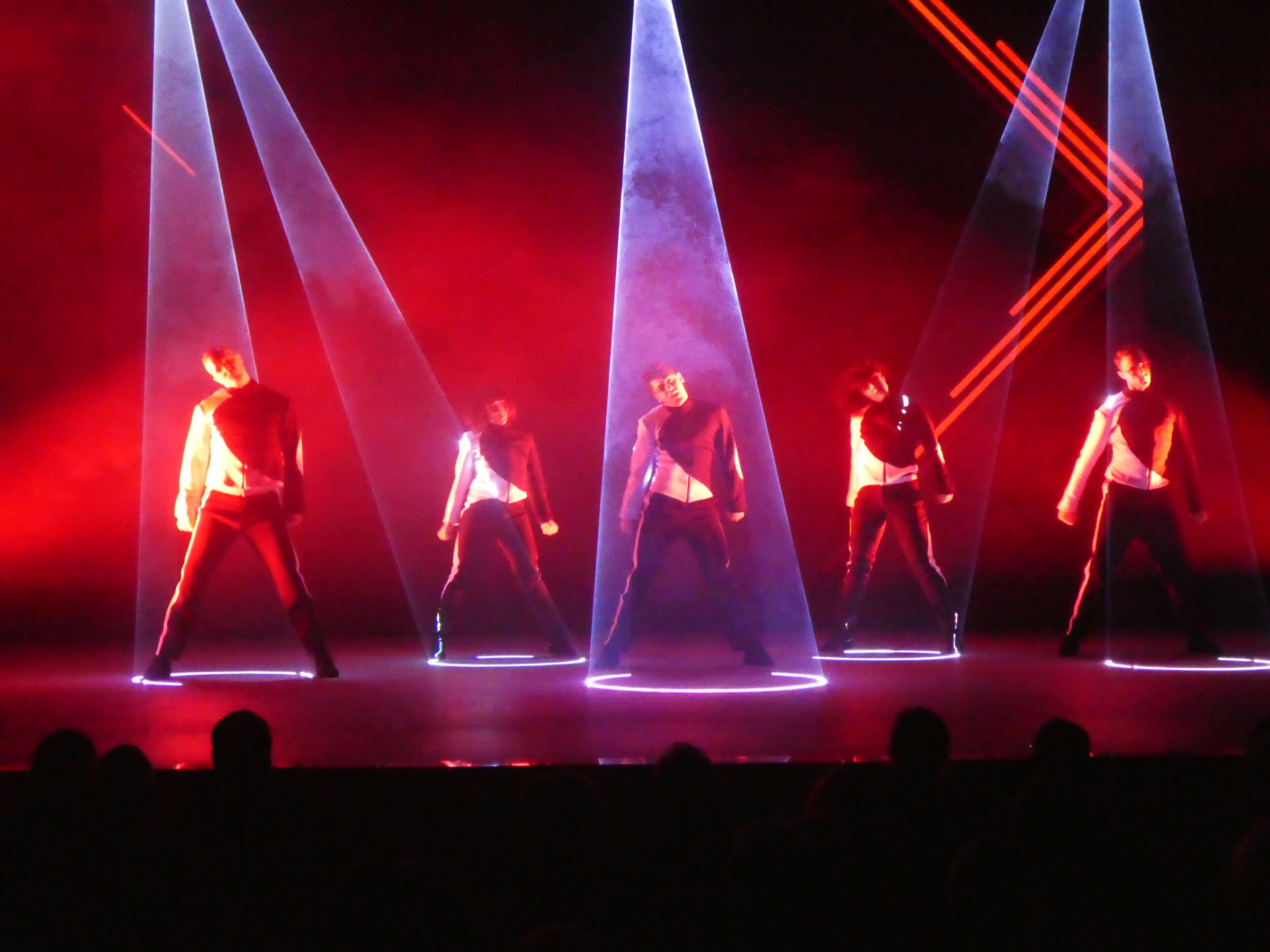
Stunning Special Effects in Eurodam Theatre.
Our favorite Music Walk venue was the Lincoln Center Stage, located towards the stern of the ship, with two or more concerts each day featuring a pianist and an exquisite string quartet – cello, viola and two violinists. Each player, a recent graduate of a top American music school, was obviously a skilled professional with a wide repertoire ranging from the classical standards – Bach, Schuman, Beethoven – to Leonard Bernstein, the Beatles and Freddy Mercury. Judging by the enthusiastic overflow crowds for each Lincoln Center performance, the smallish room used by the quintet needs to be expanded in the future.

A dynamic quintet perform at Lincoln Center Stage.
No expansion is needed in the Eurodam’s generous dining areas. The ship may be American-owned and registered in the Netherlands but the Asian food, in particular, has to be among the tastiest and most creative of any cruise line. The Lido Buffet, on Deck 9, always has a good selection of Thai, Indian or Japanese food at lunch or dinner but the best venue is Tamarind on Deck 11. This extra cost ($25 per person) restaurant in a quiet, secluded section of the ship, has charming Indonesian servers and a menu filled with visual and tasty delights - Shrimp Tempura, Shanghai Ribs, a spicy Satay Sampler, and for mains, Lime Glazed Sea Bass or Wasabi and Soy Crusted Beef Tenderloin.

Satay Sampler at Tamarind.
Tamarind was also the location of a special Asian dinner, prepared by Japanese Sushi Master Chef Andy Matsuda from Holland America’s Culinary Council. It was a five course feast, imaginative sushi of course but also included a delectable Sashimi Style Tuna Trio and Grilled Scallops Dengaku. Each course was accompanied by high end wines.

Grilled Scallops Dengaku, from Chef Andy's Special Asian Dinner.
The two other extra cost dining rooms are Pinnacle Grill, the ship’s top quality steakhouse and Canaletto, an Italian specialty restaurant.
Along with the rarely crowded Lido Buffet, the cost-included main dining room covers two floors at the rear of the ship and, on our 11 day cruise, had varied and interesting fare each evening. We were impressed. Covered with white cloths, the tables for two, four, six or eight guests have well trained, friendly waiters who presented menus with selections like Surf & Turf (tender and delicious lobster and beef), BBQ ribs, veal cutlet or chicken parmigiana The fish, especially the fresh wahoo the chef picked up in San Diego, was particularly good. Of course, vegetarian options were always available. Our only disappointment in the main dining room was with the Mexican food, offered for a couple of evenings while we were cruising along the Mexican Riviera. Very bland compared with the real thing.
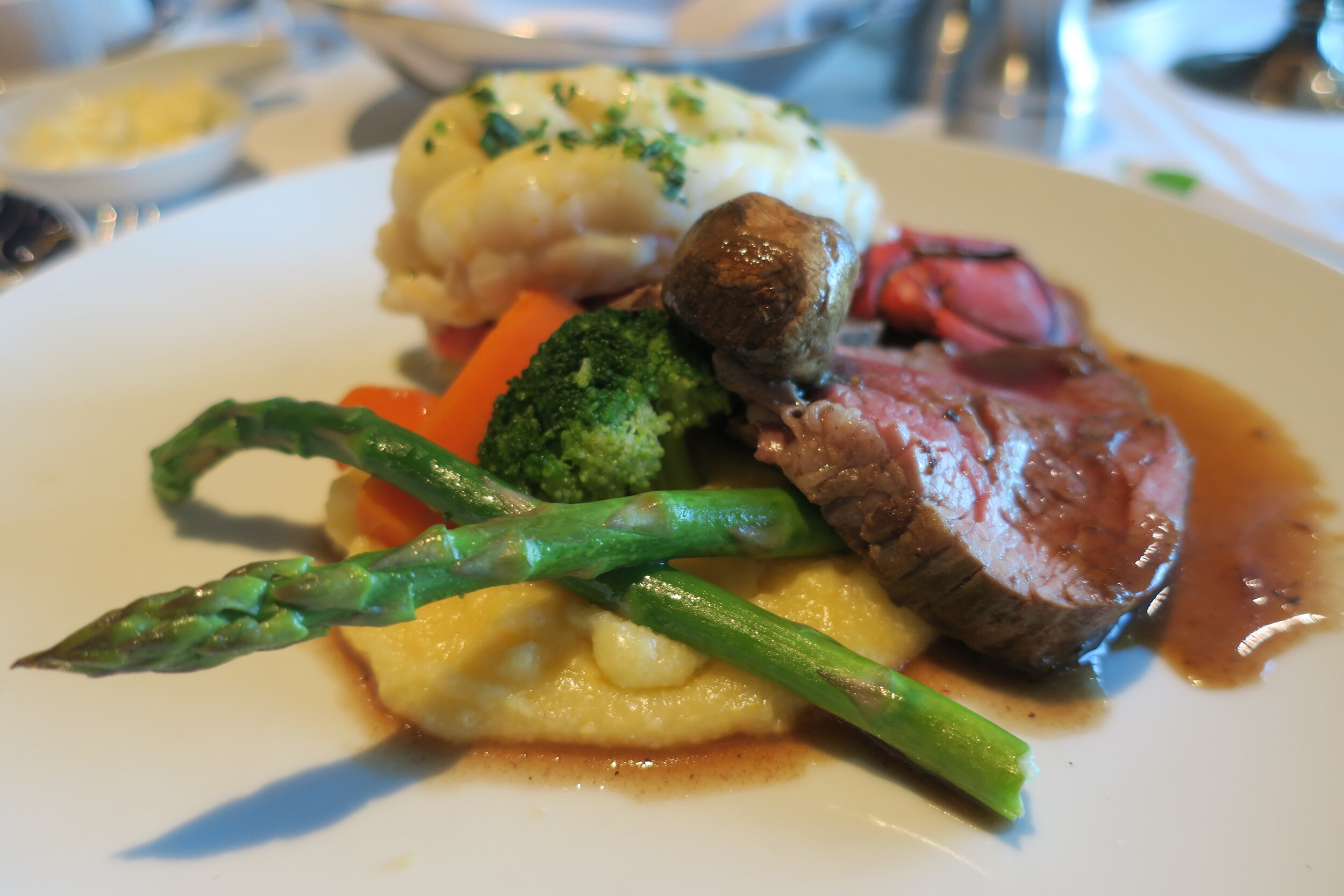
Tender Surf and Turf. Main Dining Room.
With very few miscues, cuisine is obviously very important on Eurodam. During the day, the BB King’s Blues Club is converted into America’s Test Kitchen where chefs prepare special dishes before an appreciative audience and answer questions about their techniques. Master Chef Andy showed off his sushi skills with a whimsical Panda Face roll.
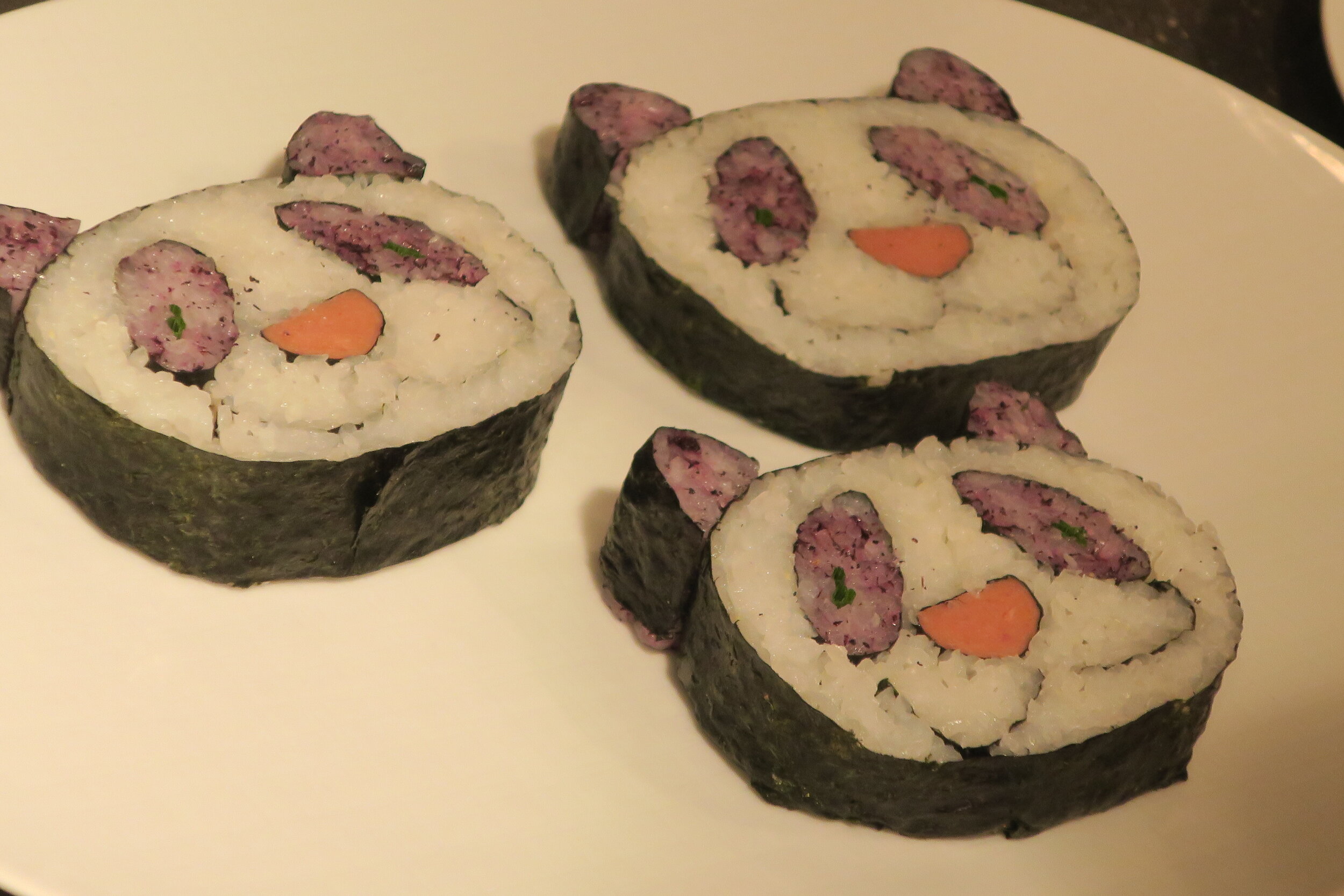
Panda Sushi. Created by Chef Andy.
Our itinerary included five sea days giving us the opportunity to fully explore the ship. From pickleball and shuffleboard courts on the top deck to the two swimming pools, observation lounges with a library, computer center, lecture rooms and a smoke-free casino, there was always something to do.
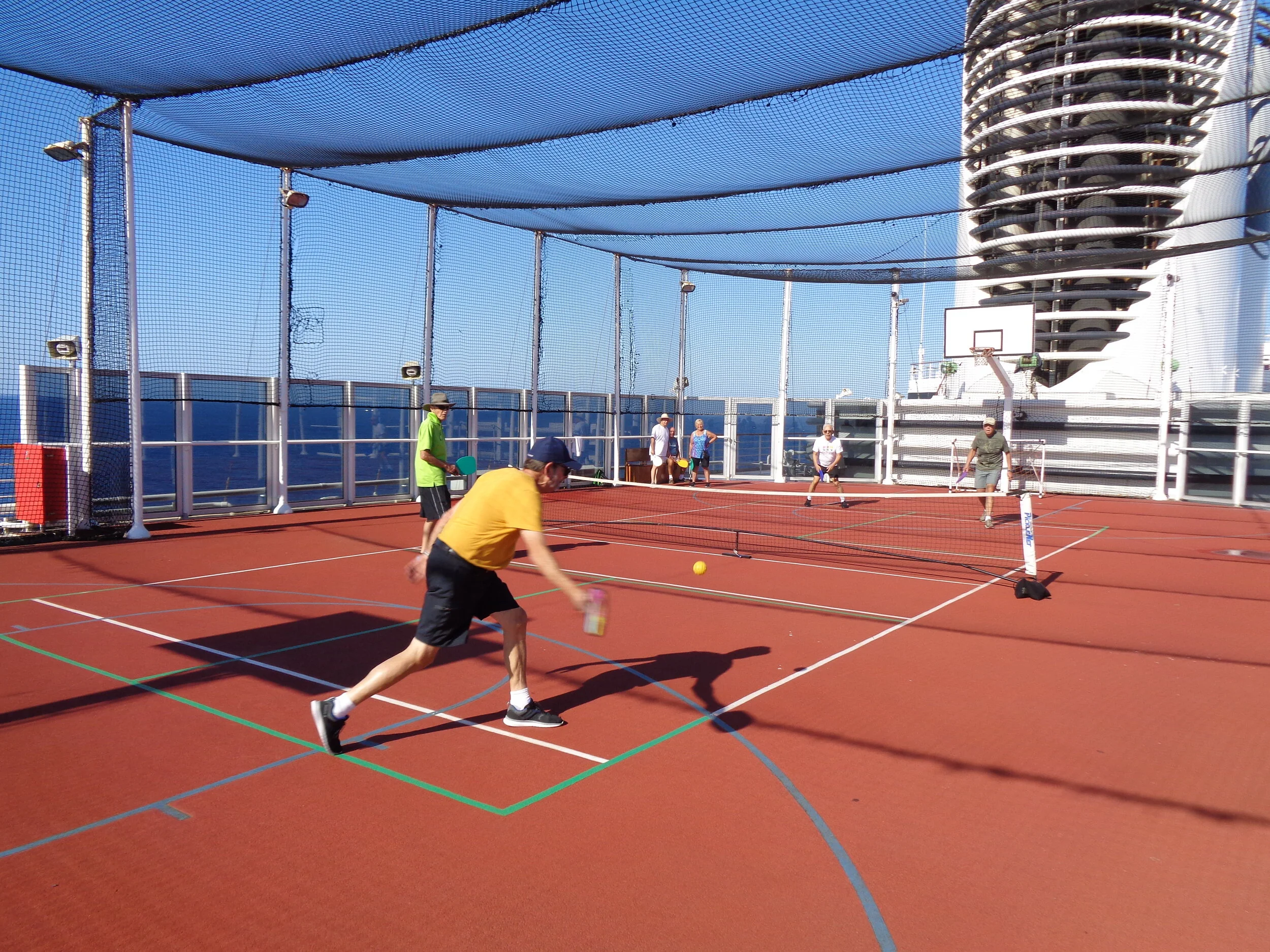
Pickleball Court on Sports Deck.
We boarded Eurodam in Vancouver, one of the most livable, picturesque cities in North America. It has an excellent cruise port facility at Canada Place and. as expected, boarding the ship was easy and efficient.
After two busy sea days we anchored off the charming California city of Santa Barbara where Eurodam’s lifeboat tenders were used to take guests ashore. This was the first of two tendering stops, both of which seemed to have delays and logistical problems.
Next day, on the pier in San Diego, we found a nearby hop-on, hop-off trolley which gave us an excellent overview of this attractive city with its palm lined boulevards. A highlight was crossing the two mile long Coronado Bridge. We can only be envious of San Diego’s semi-tropical, year-round sunny weather.

In the San Diego Trolley. Crossing the Coronado Bridge.
The Mexican Riviera offered guests a trio of fascinating cities, each with its own special attributes. Cabo San Lucas is a resort destination at the southern tip of the Baja California Peninsula. It was another port requiring a tender (with delays). The city of 80,000, one of the Top Five Mexican tourist destinations, is in a beautiful Pacific setting with pristine beaches alternating with rugged cliffs.
Mazatlan, population 500,000, is slightly off the Mexican tourist radar and thus more authentic with many colonial buildings. Its colorful waterfront walk is filled with sculptures and souvenir shops. As a thrill for tourists, daring young men dive into shallow water from a 50 foot high rock.

Colorful Souvenir Shops in all Mexican towns.
Our last Mexican port, the tourist hot spot of Puerto Vallarta. has a magnificent beach setting flanked by lush, palm-covered mountains. We chose a spirit and food tour where the chefs made us complex cocktails using raicilla, a cousin of tequila, also made from agave. This was followed by some authentic Mexican food – spicy and tasty. .

Mixing a Raicilla Cocktail in Puerto Vallarta.
As we sailed north towards San Diego and disembarkation we were glad we splurged for a Signature Suite, the lowest of three suite categories. We had a large room with plenty of storage space, a generous balcony, a huge 50 inch flat screen TV with plenty of channel and movie choices (including MSNBC, Fox News and BBC News) and, best of all, a large bathroom with twin sinks, a Jacuzzi tub and a separate shower. We were spoiled and would probably upgrade again.
At the start of the cruise, the Eurodam Hotel Director told us he’d guarantee the best live music at sea. He was right. But with the ship emerging from dry dock in 2015 and with continuing improvements since then, we’d say his prideful boast could be accurate about several other areas of this sophisticated vessel.
John and Sandra Nowlan are travel and food writers based in Halifax.
Photos by John and Sandra Nowlan

Chicago to Toronto – Cruising the Inland Sea on Victory I
“The Great Lakes – Unsalted and Shark Free”. It was an effective bumper sticker but the publisher could have added, “Wonderful Cruising”.
By John and Sandra Nowlan
“The Great Lakes – Unsalted and Shark Free”. It was an effective bumper sticker but the publisher could have added, “Wonderful Cruising”.
The Great Lakes contain fully a fifth of all the standing fresh water in the world. With 10,000 miles of shoreline, the five lakes, in many ways, dominate the geography, culture and history of North America. The region has never had the profile of ocean or European river cruising…but it should.
Chicago, with its grand buildings, many museums and outstanding cuisine was an ideal city from which to begin our cruise to Toronto.
Our ship was Victory I, a comfortable 200 passenger vessel built in 2001 and owned by Victory Cruise Lines, now part of the American Queen Steamboat Company. Its registered tonnage is just 5,000 and it’s 300 feel long. Its unusual bow is vertical rather than slanted.
Finding Victory I was a challenge. We gave our taxi driver, a 30 year veteran, a street address and told him it was at the “Chicago Dock”. “Never heard of it”, he said. After consulting his GPS with a long ride south (almost to the Indiana border), the handsome ship was finally spotted in a gritty, very unattractive industrial area. Chicago, if it wants to be a major cruise player, has to find a better port facility closer to downtown.
Once aboard the Victory I the atmosphere improved rapidly. A welcome drink and smiling crew members made registration simple and we were escorted to our room. It was small with muted, attractive colors but cleverly laid out with a surprising amount of storage space. Two large picture windows offered great views. The bathroom was tiny but quite functional with luxury touches like L’Occitane toiletries.
Before sailing, a quick tour of Victory I showed off its passenger-friendly attributes. On Deck two a comfortable Compass Lounge had enough room for all passengers and became the center for entertainment and lectures. A small library on either side of the lounge led to the “Tavern” with its bar and complimentary beer, wine, spirits and cocktails. Good complimentary wine was also available with meals in the two dining areas, the large Coastal Dining Room on Deck one and the more intimate one, The Grill, with excellent views, at the rear of Deck four. All meals were surprisingly good with our German chef and his team producing imaginative dishes like Beef Steak Tartar, Colcanon Soup, Venison Toutiere and Planko Crusted Atlantic Cod. The fish, mostly pre-frozen, was of a high quality with the very fresh Ontario trout a highlight one evening. Service from the well-trained Indonesian, Filipino and Indian waiters was very professional.
While food, service and comfort were excellent, it’s the Great Lakes itinerary that really shone. With outstanding guides, we visited both small, intimate communities and major North American cities.
Our first stop was new to most of the ship’s American, Canadian and Australian guests. On the east side of Lake Michigan, the largest city is Muskegon (population: 38,000). It boasts two fascinating World War 2 vessels that are now floating museums. The USS Silversides was the most decorated surviving submarine from the war. Visitors can walk through the claustrophobic interior and see the small galley and the crew’s bunk beds adjacent to the torpedo tubes. Nearby, visitors can also enjoy a tour through the cavernous interior and huge front unloading ramp of USS LST 393, one of only two remaining tank landing craft that were used to bring Sherman tanks and troops to the shores of Normandy 75 years ago during D-Day. More than a thousand of these versatile craft, each more than 300 feet long, were built for use in World War II.
In the afternoon another complimentary tour took us to the charming town of Holland, Michigan. As expected, the community was filled with tulips (luckily, it was tulip season) but the most interesting sight was the only authentic Dutch windmill in the US. The De Zwaan windmill was built in the Netherlands in 1761, then moved piece by piece to Holland, Michigan in 1964. Visitors can take a tour inside this working wind machine.
After a relaxing day on Lake Michigan (including elegant Afternoon Tea) we arrived at Mackinac Island, a unique US destination where cars have been banned since 1898. All transportation is by bicycle and horse drawn carriages, through the village with its 17 fudge shops and on to the historic Grand Hotel (built in 1887) with its 397 rooms and world’s longest porch. Victory Cruise Lines reserved a section of the Hotel’s huge restaurant for the extravagant Grand Luncheon Buffet.
Our first Canadian destination was Little Current, Ontario, a village on Manitoulin, the world’s largest freshwater island. It’s home to the Ojibwe People, part of the largest First Nation population in North America. All guests were invited to the nearby cultural center for a welcoming smudging ceremony and a Pow Wow, a lively exhibit of native drumming, singing and dancing.
After we re-boarded Victory I we went though the Little Current Swing Bridge dating from 1913 and past the Strawberry Island Lighthouse in Georgian Bay. Built in 1881 it’s one of the most photographed in North America.
The 1913 Little Current Swing Bridge.
Strawberry Island Lighthouse.
After small, rural communities it was fascinating to dock beside the downtowns of two major US cities, Detroit and Cleveland. It was an easy walk from the ship to the central cores. Both offer a multitude of tourist attractions so, with just a day in each port, our tour organizers chose well. In Detroit the highlight was the Henry Ford Museum, second only to the Smithsonian in Washington for cultural significance. Among the exhibits in its huge, one level gallery are the limousine that carried President Kennedy on that fateful 1963 day in Dallas, the Alabama bus in which Rosa Parks defied seat segregation laws and the actual chair from the Ford Theatre occupied by President Lincoln when he was shot in 1865. Of course there are several exhibits showing early airplanes and locomotives along with Model A and Model T Fords where Henry Ford pioneered vehicle assembly lines.
In Cleveland, Victory guests were taken on an extensive Trolley Tour of the impressive city including a drive through the 170 acre medical campus of the world-renowned Cleveland Clinic and a stop at the outstanding Cleveland Museum of Art. But next door to the ship was an architectural masterpiece, the I.M. Pei designed Rock & Roll Hall of Fame, paying homage to the greats of rock music history, from Buddy Holly to Elvis and the Beatles to the Rolling Stones and Prince. Great fun for music nostalgia fans.
Wet fun and fine wine were in store for our final day of the cruise as Victory I entered the eight locks of the Welland Canal, avoiding Niagara Falls and lowering ships 326 feet between Lake Erie and Lake Ontario. All guests were given a picturesque bus ride along the Niagara Parkway and then invited aboard one of the Hornblower Niagara Falls ships. Outfitted with red ponchos, guests sailed past the American Falls to the base of the dramatic Horseshoe Falls where wind, spray and towering cascades of water made an unforgettable impression.
Fully dried, we boarded our buses to Chateau des Charmes, one of the many fine wineries in the Niagara region where we enjoyed lunch and samples of excellent Ontario vintages. We then had free time in Niagara-on-the Lake, a charming community renowned as the home of the Shaw Summer Festival.
The next morning we woke up in Toronto in an industrial part of Lake Ontario but facing the extraordinary skyline of Ontario’s capital. It was certainly a prettier sight than the depressing view from the Chicago cruise port. The good news is that Victory Cruise Lines has promised that future Great Lakes sailings between Chicago and Toronto will use a much more convenient port, closer to downtown Chicago. A great start for a wonderful cruise experience.

Nieuw Statendam. New Ship. Brilliant Entertainment and Dining.
A review of Holland America Nieuw Statendam by Canadian journalists, John and Sandra Nowlan.
Cruise line entertainment has just taken a giant step forward. All the major cruise ships have theatres for evening production shows and most include a few other small venues for specialty acts. But Holland America Line, on its Pinnacle Class ships, has upped the ante.

Six Dancers. Amazing Special Effects.
We’ve just returned from a week-long cruise aboard the newest ship to sail the Caribbean, HAL’s Nieuw Statendam. This 2600 passenger vessel features the World Stage, the most innovative main theatre we’ve ever seen. On decks two and three, at the bow of the ship, World Stage is almost Theatre in the Round, with seats surrounding the performance area. The backdrop is a two story, 270 degree LED high definition screen with sophisticated special effects and superb sound quality. The two 45 minute shows we saw in the theatre, “Humanity” and “Stages”, from the Step One Dance Company, featured six very talented performers and dazzling, interactive use of light, sounds and action. It was brilliant.

Dazzling Dancing and Special Effects in Main Theatre.
Also brilliant on Nieuw Statendam are the ship’s four other entertainment venues. Called the “Music Walk”, the mid ship area has something for every musical taste. We particularly loved the Lincoln Center Stage and its group of five remarkable classical musicians – a pianist and a string quartet. In addition to traditional favorites (Bach, Schumann) the quintet performed music from the movies – Star Wars, Psycho and many others. Lincoln Center shares its stage with BB King’s Blues Club, eight talented musicians who bring the crowd alive with southern blues and classic soul.

Lincoln Center Stage.
Classic rock is not forgotten. Five young rockers perform three shows daily in the Rolling Stone Rock Room, a partnership with Rolling Stone Magazine. Across the corridor, two singer/pianists alternate performance times with the rock group and honor all time Billboard Magazine hits. It’s very interactive with lots of stories and requests from the audience.

Rolling Stone Rock Room. Loud, but Fun.
In addition to entertainment, a priority for most cruise ship passengers is the dining. Like its sister ship, Koningsdam, the Nieuw Statendam has a bright, two story, main dining room with red and clear glass chandeliers. The innovative design reminded us of giant whale bones. It’s open only in the evening but there are plenty of other dining choices. The Lido Market on deck 9 is the main buffet venue and is cleverly divided into various food islands so crowding is minimized. Food choices are excellent, especially at breakfast. The coffee is not great but better than on most cruise ships. Other areas for complimentary food include the New York Deli and Pizza (very good pizza) and the Dive-In for excellent hamburgers and hot dogs. The hamburgers at Guy Fieri’s Joint on Carnival ships are still a bit better.

Main Dining Room. Like being inside a whale.

New York Pizza. Excellent.
Nieuw Statendam includes several extra-cost dining areas. We were able to sample four of them. Rudi’s Sel de Mer (named for Holland America’s Master Chef, Rudi Sodamin) is a French-Mediterranean brasserie. One recent survey claimed it had the best seafood at sea. We agree. From the massive Fruits de Mer appetizer (King crab legs, langoustine, crab claws, jumbo shrimp, mussels and clams) to marinated lobster, Dover sole, scallops, sea bass and salmon, we were impressed by the fish quality and innovative presentation. We also has an excellent meal at Pinnacle Grill, the ship’s US Northwest inspired steakhouse. It’s hard to beat a great steak, perfectly cooked. Tamarind is the ship’s 140 seat restaurant that features cuisine from Southeast Asia, China and Japan. We enjoyed giant Indochine tempura shrimp and Mongolian lamb chops. Every evening a portion of the Lido Market becomes Canaletto, an excellent Italian restaurant that’s now part of almost all Holland America ships.

Seafood Appetizer at Sel de Mer.

Mongolian Lamb Chops in Tamarind.
Food is taken very seriously at Holland America so we weren’t surprised at the popularity of America’s Test Kitchen (cooking demonstrations in the main theatre) or the tour of the sparkling, stainless steel galley and its 200 chefs and cooks.

Test Kitchen.
Because of its Dutch heritage, large elegant floral arrangements are scattered throughout the ship. Another delight is the creative artwork on every staircase and in most public areas. We love quirky and the 3D artwork and unusual sculptures delivered many smiles. On Deck Nine there’s even a six foot glass reproduction, anatomically correct, of Michelangelo’s “David”. For fun, he’s holding a smart phone for a selfie.

Michelangelo's "David". Taking a selfie.
Fort Lauderdale, with easy access from the nearby airport, is the current base for Nieuw Statendam. Our Eastern Caribbean itinerary took us first to Nassau, Bahamas, a very popular cruise destination (when we were there, five large ships were docked next to each other). We took the boat tour to nearby Blue Lagoon Island with some quiet beaches and the well-known Dolphin Encounters. Close interaction with these marine mammals is very popular and they seemed to be well cared for.
After a welcome day at sea we arrived at the Commonwealth of Puerto Rico, a Territory of the United States. It was a delight seeing the 16th Century landmark fortifications and the Spanish Colonial buildings in the Old Town, now a UNESCO Heritage Site. We joined a Spoon Food Tour led by Pablo, an entertaining guide, who knew the history of every nook and cranny and who introduced us to some unique Puerto Rican cuisine – Mofongo (the national dish of fried plantain with chicken and sauce) and Pernil (marinated roast pork with beans, rice, ceviche and churros).

Mofongo. National Dish.
That fascinating city was followed by another sea day and two beach days, first at Trunk Bay Beach on the island of St. John, a half hour boat ride from our landing in St. Thomas. The beach was wonderful (great snorkeling) but we passed evidence of much destruction from recent hurricanes. The last beach day and our last onboard (we love Caribbean beaches, especially during our winter) was on Holland America’s private Bahamas Island, Half Moon Cay. Reached by large, efficient tenders, the white sand beach is superb with the clearest ocean water we’ve ever seen. Some guests chose optional horseback riding, kayaking or Sea-Dooing. There were plenty of beach chairs available. Back on board the ship offered its guests cold towels and drinks. Even some ultra-luxury lines don’t do that anymore.

Private Island Beach. Crystal Clear Water.
We were sad to leave Nieuw Statendam and head for home (disembarkation was remarkably fast and efficient). This was the sixth Holland American ship, dating back to 1898, with the proud Statendam name. Earlier travellers on its namesake would have been astonished by the dramatic, positive changes in comfort, cuisine and entertainment.
John and Sandra Nowlan are travel and food writers based in Halifax.